Art Is a Right: Review of the Book 'Culture Is Not an Industry'
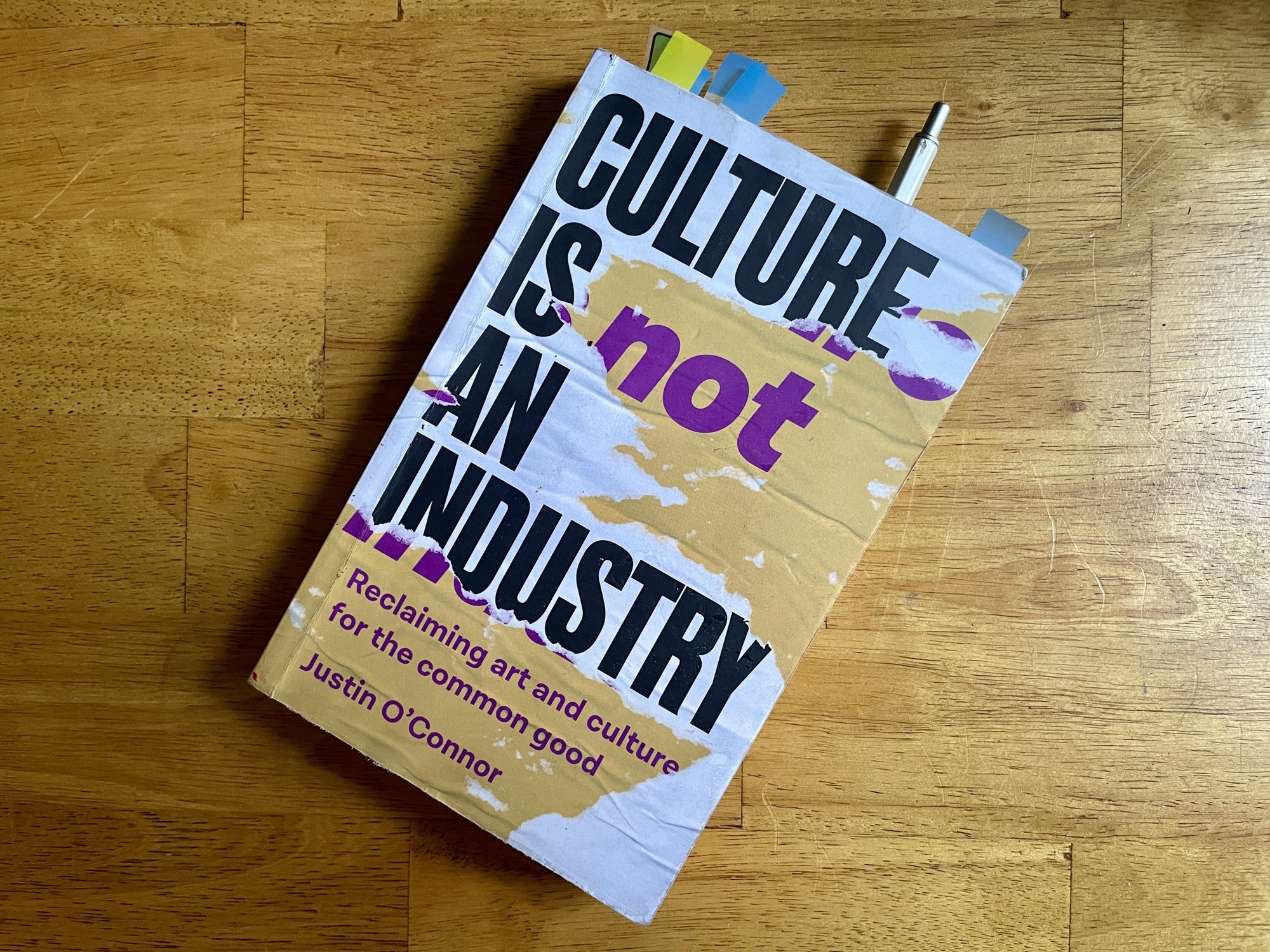
Culture is Not an Industry by Justin O’Connor, Manchester University Press, 2024
8 minute read
-
Post’s Key Takeaways
- “Creative Industries” is an advocacy framework for increased investments in arts and culture that positions the sector as an economic driver.
- Despite its prominence in the past 2 decades, the framework lacks a coherent understanding of what constitutes a “Creative Industry”.
- It is also largely failing its purpose of securing adequate support for arts and culture.
- At the same time, the sector struggles with articulating its value beyond economic impact.
- Culture is Not an Industry reframes culture as a human right for meaningful life.
- In the new framework, the cultural sector should be evaluated by the degree to which it facilitates people’s right to culture.

Economics … simply cannot deal with the future. But culture can.
The 2018 report on my state of Ohio’s creative industries claims an economic impact of ~$41 billion, equivalent to a whopping 6% of the state’s GDP. Arts and culture professionals find this statistic useful for advocacy and embed it in requests for funding, tax levy campaigns, and policy documents. For example, in 2024, the Ohio Arts Council cites the report in the opening paragraph of its annual budget request, framing funding for the arts as an economic investment.
However, those who peek inside the report find a strange world where artists, museums, and dance companies occupy the same space as promoters of sports, radio and TV broadcasting, architectural engineering, publishing, sign manufacturing, and many more. In fact, the non-commercial sectors take up only 3 out of 15 listed categories.
This confusion is indeed reflected in the advocacy efforts. In return for the presumed $41B impact, the Ohio Arts Council requests an investment of meager $25 million—0.06% of the stated economic impact, 0.003% of the state’s GDP, equivalent to the budget of one cultural institution spread thin over the entire state.
In doing so, Ohio is representative of a global phenomenon. Almost universally, advocacy for public and private investments in the arts and culture touts the sector as a major contributor to the economy. Just as universally, these efforts fall short, and have been doing so for quite some time.
Culture is Not an Industry offers a fascinating analysis of this failure. However, that by itself is not why I am writing this.
Why ‘Creative Industries’?

Advocacy is integral to arts and culture due to the sector’s dependence on the goodwill of policymakers, funders, and the general public. Finding satisfying language for this work has always been a pain.
Of course, understanding the proverbial intrinsic value of the arts is the pursuit of the humanities: the labor of countless philosophers, theoreticians, historians, and artists, which, in itself, is a substantial part of human cultural heritage. Translating this heritage into the language of advocacy is not a trivial task.
And if you, like me, work at the intersection of the arts and other fields, articulating art in accessible terms becomes not just the stuff of books and documents but part of routine daily conversations with collaborators, stakeholders, and grant officers.
One approach to simplifying this task is to show the arts’ instrumental value to non-arts things whose value is easier to communicate. This is the logic that led to the invention of Culture-As-Industry when, in 1997, Chris Smith, then UK’s Minister of Culture, Media and Sport, set out to convince the Treasury to reverse 20 years of cuts to culture budgets. The proposed solution was to rebrand “Arts and Culture” as “Creative Industries”.
“Art” might be perceived as elitist, but not “Creativity”: everyone can be creative! “Industry”, in turn, indicates that the sector contributes to something more tangible and easy to articulate than the ever-elusive “intrinsic value of the arts”: the GDP.
Thus, the arduous job of the humanities could be replaced by a much more bureaucratically accessible one of accounting. The idea caught on rapidly and was adopted on a global scale by governments and funders alike.
But what exactly are “Creative Industries”? As O’Connor points out, 25 years later we are none the wiser:
Attend a dairy or wine or car industry conference, and there will be all sorts of conflicts over organics and electrics, government regulations, and new markets. They will not spend three days talking about what the dairy industry is, or cleverly counting leather-derivative producers and pâtissiers as embedded dairy farmers. Or be in a position such as at a recent creative economy conference in India during which rocket engineers were discussed in the same category as rural village weaving co-ops.
Culture is Not an Industry is not a book about advocacy, but a deep analysis of the socio-economic circumstances that brought about the concept of Culture-As-Industry, and the reasons for its inadequacy. However, from my perspective as an arts practitioner who has spent years navigating the sector, it is the advocacy aspect of the book that I find most applicable.
Culture as a Human Right

Culture-As-Industry began as a well-intentioned attempt to facilitate increased investments in the arts. These investments never materialized.
But not only that: decades of intense efforts on evaluating the economic impacts of an ill-defined industry induced a devastating paralysis of the cultural sector’s ability to articulate its worth in any other terms, and to envision a path forward.
Culture is Not an Industry proposes such path: to consider culture as a fundamental human right and societal necessity.
The idea of human rights stems from age-old philosophical discussions of “needs” and “wants”. There are things humans must have to survive: food, water. Then there are “nice-to-haves” which improve life but are not seemingly essential for survival.
The boundary between “needs” and “wants” is far from fixed. Once people are fed, they need shelter, education, healthcare, safety, and other things which, depending on the state of society, can be assigned to either category. This philosophical discussion has very practical consequences: allocations of resources in society depend on governing perceptions of what is considered a “need”.
But what makes life livable are things beyond sustenance. The author brings in Robert Kennedy Sr. (1968) to make this point:
[T]he gross national product does not allow for the health of our children, the quality of their education or the joy of their play. It does not include the beauty of our poetry or the strength of our marriages, the intelligence of our public debate or the integrity of our public officials. … It measures everything, in short, except that which makes life worthwhile.
Therefore, the whole needs vs. wants debate is a red herring: what’s the point of having one’s physical needs satisfied if life isn’t worth living? Exit survival, enter livability: the complex of factors that makes life meaningful, including, among many others, identity, affiliation, participation, creativity, and experience.
In short: Culture.
The “realm of necessity” and the “realm of freedom” are both essential parts of our lives in common. We cannot think one without the other. Culture straddles these two realms - it is a basic need, present in the darkest recesses of material deprivation, but part of the need it satisfies is a freedom over and above that necessity.
Here’s my paraphrase of this claim.
Creating and experiencing art is not something we have to do to survive. Rather, it is something we choose to do to satisfy a fundamentally human necessity to give life meaning.
The prehistoric human chose to crawl in complete underground darkness to create paintings on cave walls, despite having allegedly more important things to do such as evading predators and foraging for food. That choice was their human expression of freedom, and their art is the material manifestation of that freedom.
Therefore, restricting your freedom of access to identity, affiliation, participation, creativity, and experience—your access to culture—makes you a less free human. Thus, the value of the arts is decoupled from “measurable outcomes” such as economic impact, and attached to a foundational human right that does not require an external justification.
Cultural Infrastructure

What follows from this proposition is a fascinating (for a recovering arts administrator) concept of Cultural Infrastructure.
Just as our belief in access to water as a human right facilitates investments in water infrastructure, our belief in culture as a human right should facilitate investments in cultural infrastructure: a complex of systems supporting people’s ability to achieve meaningful lives. It consists of institutions and their capacities, including “hard” elements—buildings, facilities—as well as “soft” ones: programs, services.
To continue the analogy: our right to clean water translates to public investments in water infrastructure: water mains, treatment plants. The measure of success of these investments is the extent to which people have access to clean water.
Similarly, insofar as everyone has the right to lead a meaningful life, everyone should have access to culture that they find meaningful. Therefore, the effectiveness of the cultural infrastructure is evaluated by the extent to which people have access to culture.
This feels like something arts administrators should be able to work with.
A New Direction for Arts Advocacy

This discussion is not about our understanding of what arts and culture are: it’s about rhetorical devices we use to advocate for their value. It helps, however, when these devices represent reality.
The concept of creative economy is not only untruthful to the roles of the arts in the world: when was the last time you went to a museum or concert motivated their contribution to economy? It is also an ineffective advocacy tool which has clearly outlived its welcome, wreaking much havoc while failing to deliver on its single goal: securing investments that are adequate to culture’s role in society.
Fixing this requires the arduous task of crafting a new theory and language for arts and culture advocacy. Culture is Not an Industry proposes to begin like this:
- Culture is a human right and the mechanism by which society facilitates meaningful lives of its citizens.
- The right to culture translates to the freedom to have a meaningful life.
- The effectiveness of the cultural sector should be evaluated by its capacity to facilitate this right.
- The goal of arts and culture advocacy, therefore, is to foster growth of this capacity.
While I can’t comment on the scholarly qualities of O’Connor’s economic and political arguments, I confidently recommend this book as mandatory reading for arts administrators, artists, policymakers, philanthropists, curators—anyone in a position to begin rescuing the arts from their “industry” and place them where they belong: in people’s lives.
The sad state of democracies and environments worldwide is a sobering case study of the damage self-inflicted by societies losing their sense of meaning and freedom; a tangible manifestation of what O’Connor aptly calls the atrophy of the sense of future. The arts have a role in repairing our collective senses. Culture is Not an Industry proposes, if not a fully developed path forward, at least a promising direction.