the only thing I've done is I'm an artist figuring out what an artist is
Instead of an Obituary
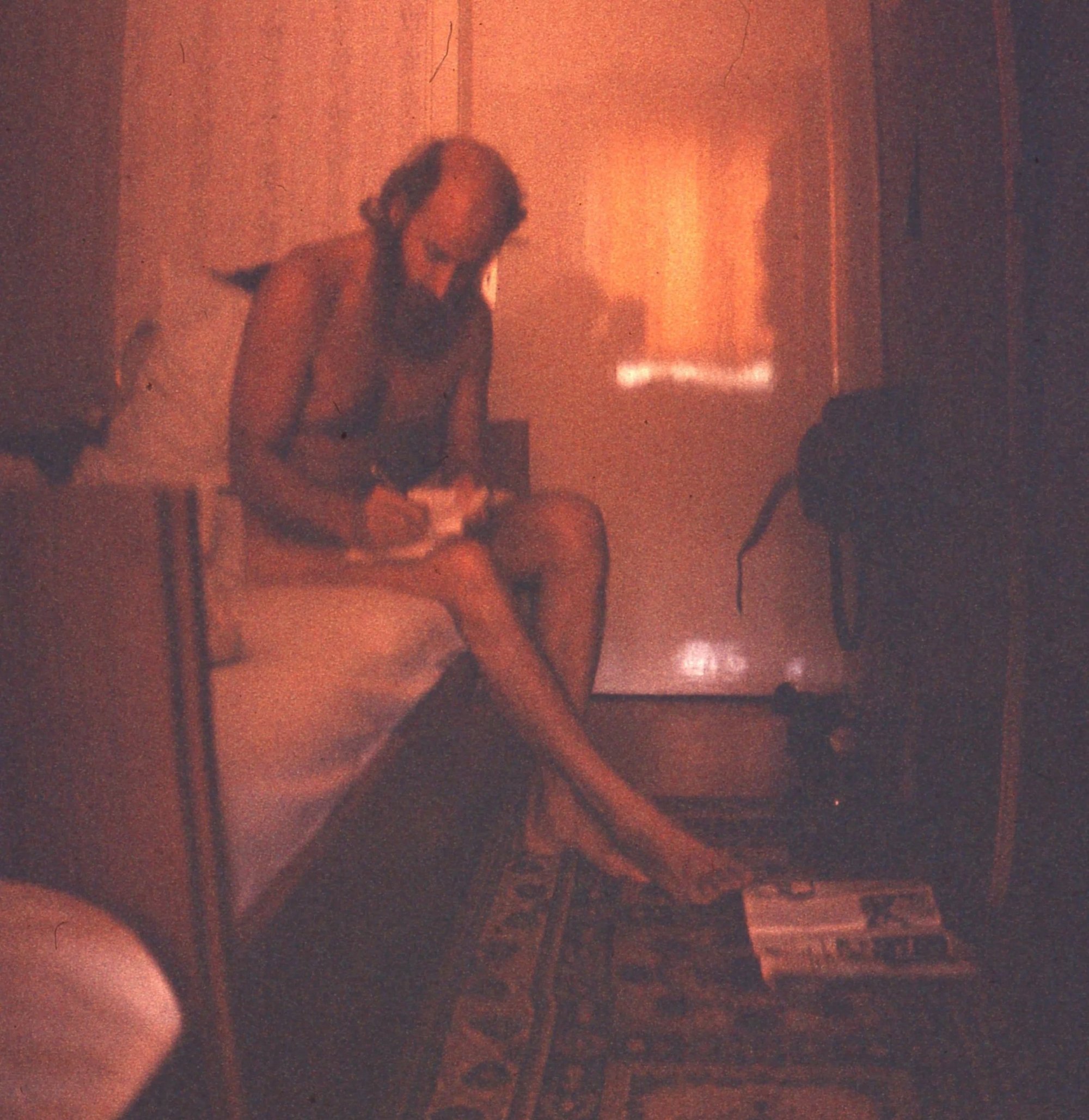
Photograph by Larry Bell
-
Introduction to the first interview publication (2018)
First edit of this interview was published in October 2018 on the Weisman Art Museum’s website.
A bus brings a group of people, most wearing suits, white shirts, and ties and carrying briefcases, from the downtown Intercontinental Hotel to a troubled oceanside neighborhood of hippies, surfers, homeless, and artists. They disembark by the beach and wander down a decrepit alley toward a recently made hole in a brick wall. They step through the hole, pass by a pile of rubble, and walk down a small corridor into a large, dimly lit room with slightly colored skylights in the ceiling, white columns at one end, two rows of facing elevated red canvas chairs in the center, and pillows spread on the floor. The time is the morning of May 11, 1970; the place is the studio of minimalist painter Robert Irwin in Venice, California; and the event is the First National Symposium on Habitability of Environments by NASA.
“Frequently mentioned but routinely under examined,” this unlikely constellation of contexts, places, and characters was the brainchild of Irwin and his friend and collaborator Edward (Ed) Wortz, an experimental psychologist, then of the The Garrett Corporation. Irwin redesigned his studio with the help of his neighbors artist Larry Bell, art fabricator Jack Brogan, and architect Frank Gehry. The facing rows of folding canvas chairs (Gehry’s idea) were for the panelists: the intentionally uncomfortable seating was meant to make it physically impossible to relax. The rest of the participants were invited to sit—or lie, as many eventually did—on the floor. The red chairs and Bell’s skylights contributed the only color to the space that otherwise was, on its first day, uniformly white.
On the second day of the symposium the participants followed the same route and arrived at the same studio. The white columns were gone. Where the columns had been there was now a large opening to the outside covered by a translucent paper: light and sounds of the street entered freely into the studio, which made it more difficult for the panelists and the audience to hear the speakers. The additional effort invested into perceiving the content established in their consciousness the interconnectedness of the event and its surroundings. This connection was further reinforced on the third day, when all separation between the symposium and the outside disappeared: the translucent paper had been torn down and the symposium became open to and accessible from the street, with occasional curious passers-by drifting in (“drunks and beach bums and young kids”).
The participants ate their lunches on the curb outside. The afternoon discussion groups convened in Irwin’s second studio as well as in other artists’ studios nearby—those of Larry Bell, De Wain Valentine, and Ed Moses. One of those spaces, designed by Irwin, had uniformly lit, edgeless white walls that focused the discussants’ attention on their fellow participants: there was literally nothing else to fix the gaze on. Another room, one of Bell’s, had angled walls that made the acoustics so reverberant that speech became unintelligible: participants had to be near each other and speak softer. Still another of Bell’s rooms was small and painted black, with one bare incandescent bulb hanging in the center: it was considered by many to be overly oppressive. Most attendants found the discussion rooms untenable and eventually took charge of their working conditions, relocating their sessions to the nearby beach or the grass lawn.
I interviewed Robert Irwin at his home in San Diego, California, during two hour-long sessions on March 15 and 16, 2018. The conversation about events from nearly half a century ago inevitably wandered through many topics, and I edited the interview to its present form so that it would be directly relevant to the symposium. I kept the original language and style of Irwin’s speech intact wherever possible.
The interview was preceded by three days of research in the archives of LACMA and the Getty Institute, in order to prepare for the Second National Symposium on Habitability of Environments. This explains the context for some of questions and comments in the interview.
-
Introduction to the expanded edit (2026)
Almost exactly five years after the first interview edit was published Irwin died, and I posted this on my now defunct LinkedIn account, accompanied by Larry Bell’s photograph of naked Irwin:
Robert Irwin died. If you ever talked with me about art, you’ll know that I will mention his name in the first 5 minutes. Even though we’d only met once, there is no other person outside of my immediate family who had such a profound intellectual impact on me and such a material effect on my life.
This photo of naked Irwin writing, taken by Larry Bell in a London hotel in the 70s, feels like an adequate encapsulation of him and his position in the arts: perpetually unsettled, tirelessly pedagogical, forever exposed and vulnerable but constitutionally unable to play it safe.
The most hurtful thing the world can do to an artist is to stop paying attention - and it did, and Irwin kept on. Well, look at the world now, with its atrocities happening as regularly as its art fairs… I hope he is in a much better place now, as fiercely as a non-believer can hope.
That bitterness I hinted at was not an aside. It ran through our entire 2018 conversation, and I’ve been grappling with how to handle it since. I planned to follow up on the LinkedIn post with a full obituary, but never did, partly because of that. Instead, with a delay of more than two years, I am publishing this expanded edit of the 2018 interview.
The original version focused on the Symposium, and so I edited out Irwin’s many digressions. Now, after his death, these digressions feel important: his thoughts about art and teaching, his historical anecdotes. And, most uncomfortably, that bitterness about the art world, his profound resentment of its workings, and disappointment with the futility of his efforts to change it for the better.
We often treat resentment and bitterness as undignified, the dirty laundry of private conversations over drinks. But when an artist of Irwin’s experience and commitment tells us the system failed him, that’s not gossip. That’s evidence. We can either learn from it or keep falling into the same traps.
You be the judge.
My Second National Symposium on Habitability of Environments never materialized. We assembled a motley team of scientists, artists, historians, and architects, who gathered in my home in Minneapolis for a day-long workshop in October 2019, followed by an event at the Weisman Art Museum. We developed an ambitious proposal for a new habitability symposium: a year-long series of local events produced by cultural institutions across the US and Canada, a kind of distributed social sculpture. We just couldn’t get it funded.
March 2026
One interesting thing about being an artist now is that everything is a possibility. Which means you start out of the state of total chaos, and you have to assume the responsibility for every single thing you do or do not do.
Robert Irwin, interviewed in Drugs and Beyond, Extension Media Center, UCLA for the National Institute of Mental Health, 1971.
Footage of the First National Symposium on Habitability of Environments. Venice, CA, 1970. Camera: Larry Bell. Editing: Boris Oicherman.
***
Robert Irwin: [Gets off phone] It’s my friend Jack Brogan.
Boris Oicherman: He also participated in the symposium, didn’t he?
RI: Yes. Jack and I have been working together for about 50 years. Conservators are trying to get information from him because he knows things they don’t. He’s my age, so he won’t be around much longer, and he’s the one who knows everything. Art restorers are trained to restore paintings, but paintings are just a small part of conservation work now. Anyway, that’s another story.
The art and technology thing. All right, just to put it in perspective. It started with people in New York trying to find ways for artists to stop being isolated, as they put it, with their heads in the sand. They believed artists should engage with new knowledge developing in the world.
It came to the West Coast through Maurice Tuchman at the Los Angeles County Museum (LACMA). He decided to do the Art and Technology Project, asking leading artists to participate. He asked me and I told him, “No.” When he asked why, I said, “Because it shouldn’t have anything to do with technology. It should have to do with a dialogue between artists and scientists. That would be a really interesting exchange where they could learn from each other.”
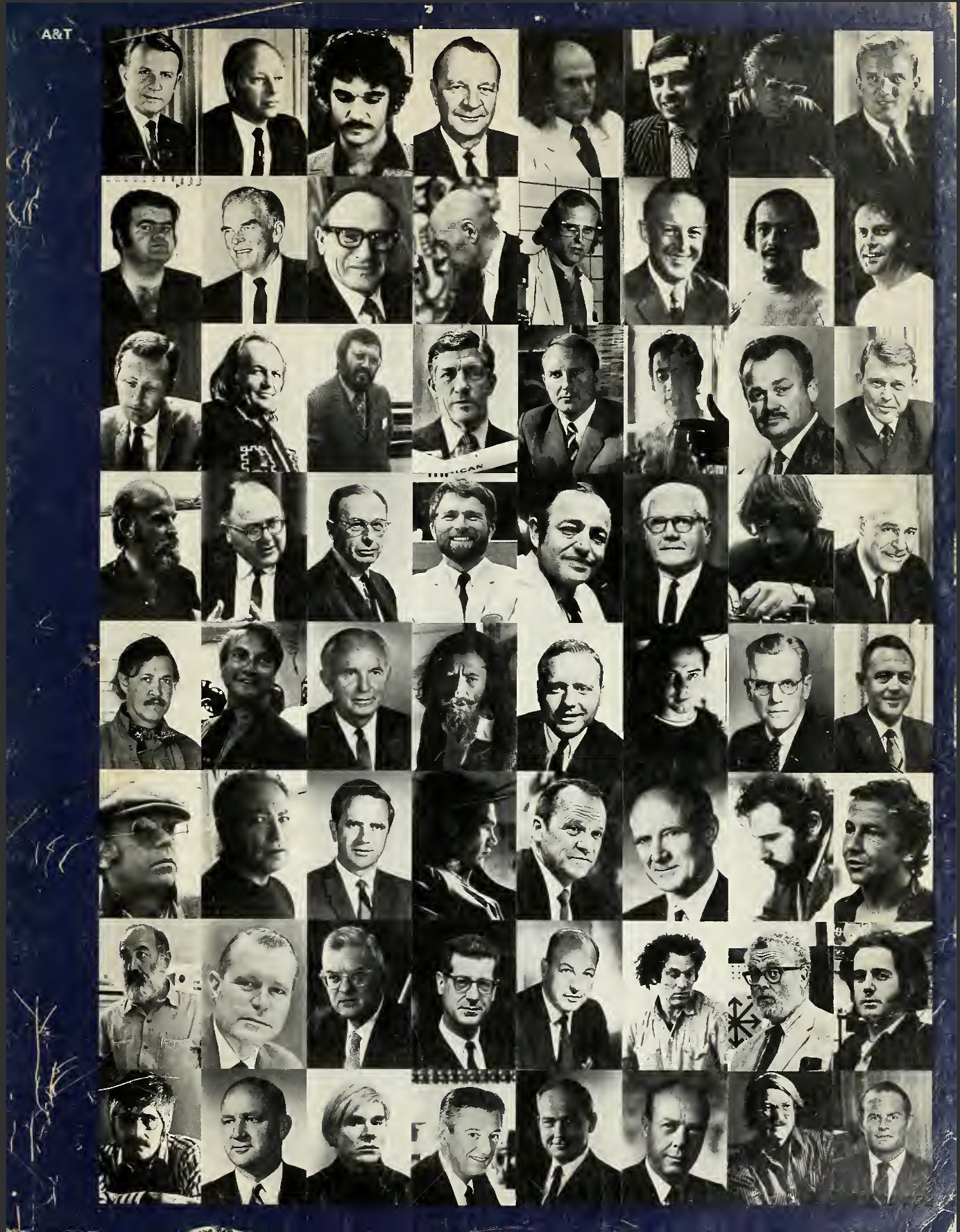
Cover: A Report on the Art and Technology Program by the Los Angeles County Museum of Art 1967-1971
He first just dropped me out of the program and then at the last minute he decided to let me in. He arranged a trip for me with Richard Feynman, to take me around all the big stuff that was happening in Southern California. Feynman came to the airplane, sat down next to me and started drawing portraits of people. He took me to all the places, IBM, the people doing the “travel the universe” stuff. They were thrilled to have him come. And it was interesting to see the interaction between them. You could tell who was the main man in the room. But he hadn’t the slightest idea, at least from my perspective, what artists can and should be doing. And I of course had no idea about physics.
He told me how his father used to take him to the woods. A bird would go, “Tweet, tweet,” and dad would tell him it’s a robin or whatever. They did this for many birds, and then father said, “What do you know now?” Richard showed him what different birds sound like, and his father said, “You don’t know anything. All you know is a name and little sound. What actually is that bird?” Feynman told me that was the beginning of his inquiry.
He asked me, “What do artists do?” And I said, “What do you think?” And he told me about being a painter, a sculptor. I said, “You’re telling me the names of the birds. But you’re not identifying anything.” It took a few days, and we actually started having a really interesting conversation.
At one of the places I eventually went to, called Garrett, there was this guy who had some wild equipment all over him, Ed Wortz. He was studying the physiology of walking on the moon, like figuring out how much energy it takes to go up a 20% slope. He sat down and also asked, “What do artists do?”
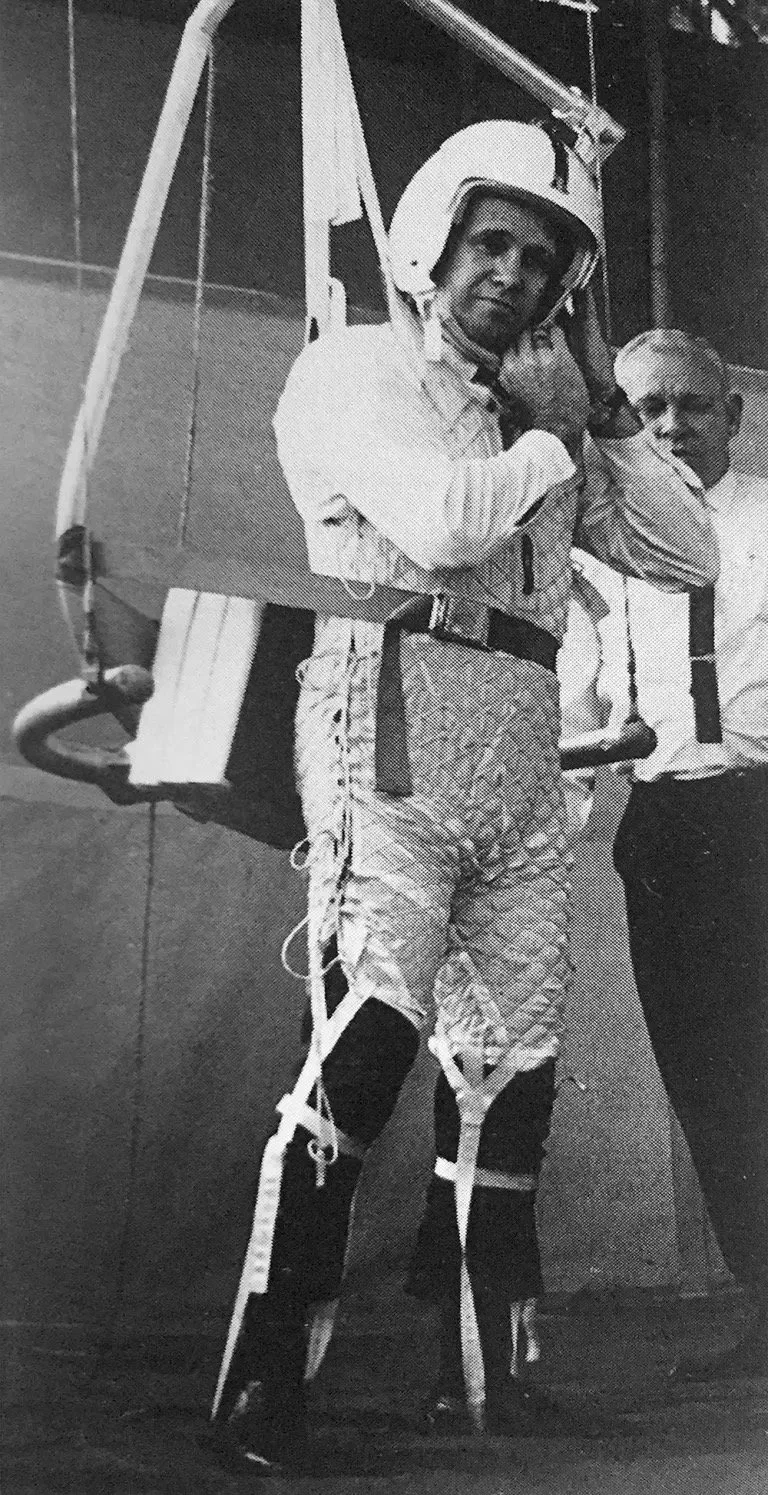
Ed Wortz. Photographer unknown.
So he and I too started a conversation, and it carried on: he was maybe one of the most important people in my life over the following 20 years. And maybe I was important to him because in the end he no longer worked at Garrett, he’d become a therapist, shrunk every artist in LA. My dialogue with him had become indispensable for me, we really had a meeting of the minds.
Anyway, soon after we met, he was asked by NASA to do a symposium on habitability in long space travel. This was a very high level event, high energy. NASA had the resources to attract whoever they wanted, so people came from all over the world.
He asked me to give a paper. I thought for a while about what happens in those events and what I could do as an artist. How would I communicate with these people? What kind of knowledge could I contribute, going back to Feinman’s birds. And I decided, “I’m not going to give a paper. I’m going to fuck with their habitability.”
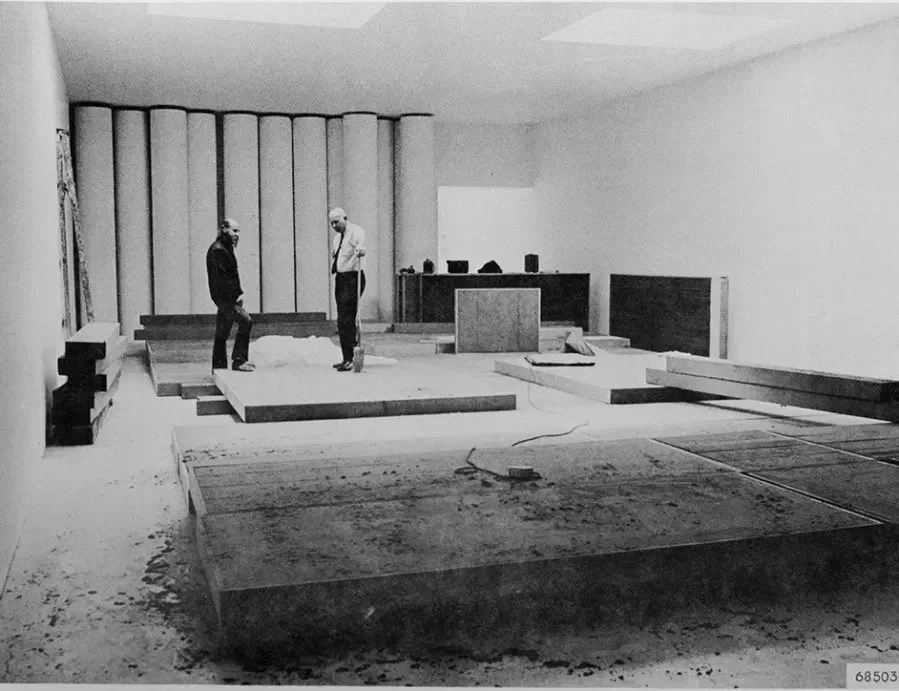
Normally, what happens in these events is, they come to town, stay at the Intercontinental downtown, go down to the conference room, sit around a table and talk. Instead what I did was: I prepared my studio in Venice to hold the symposium. I cleared the thing out and transformed it.
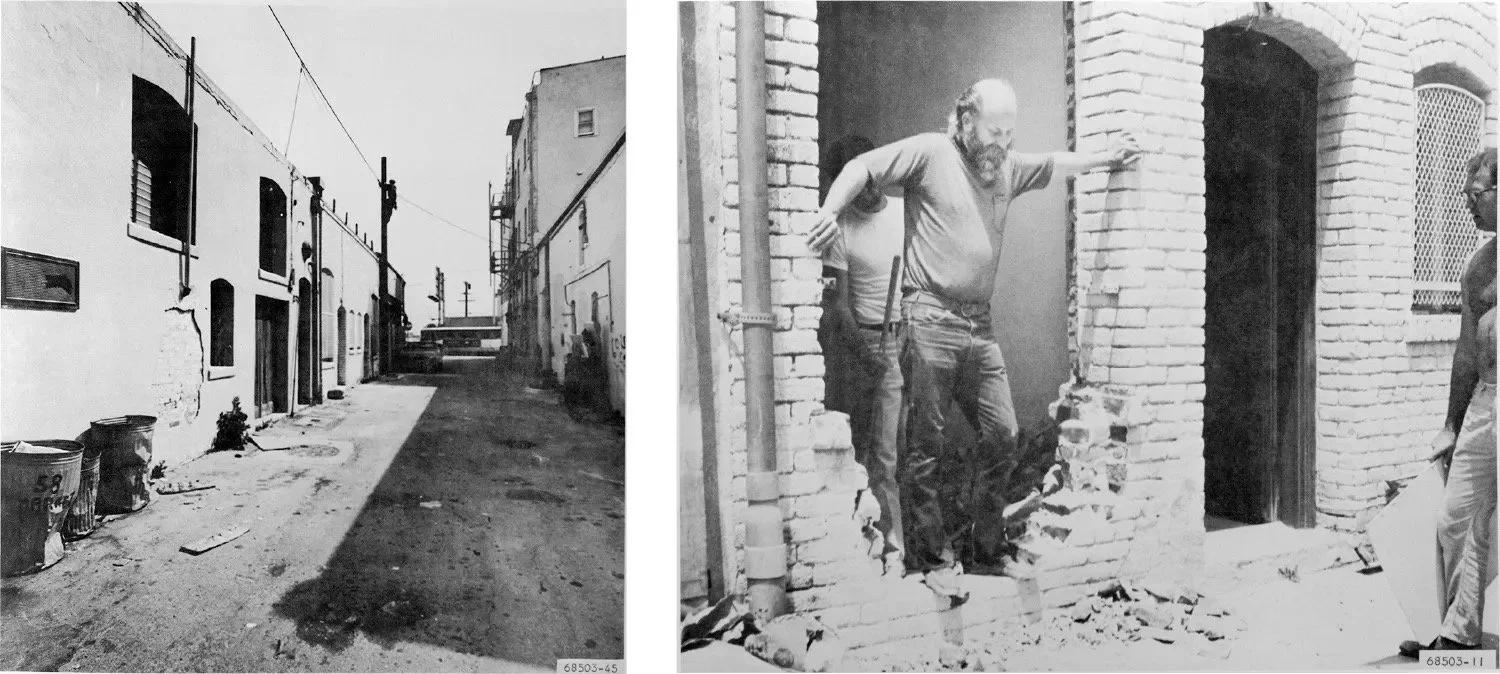
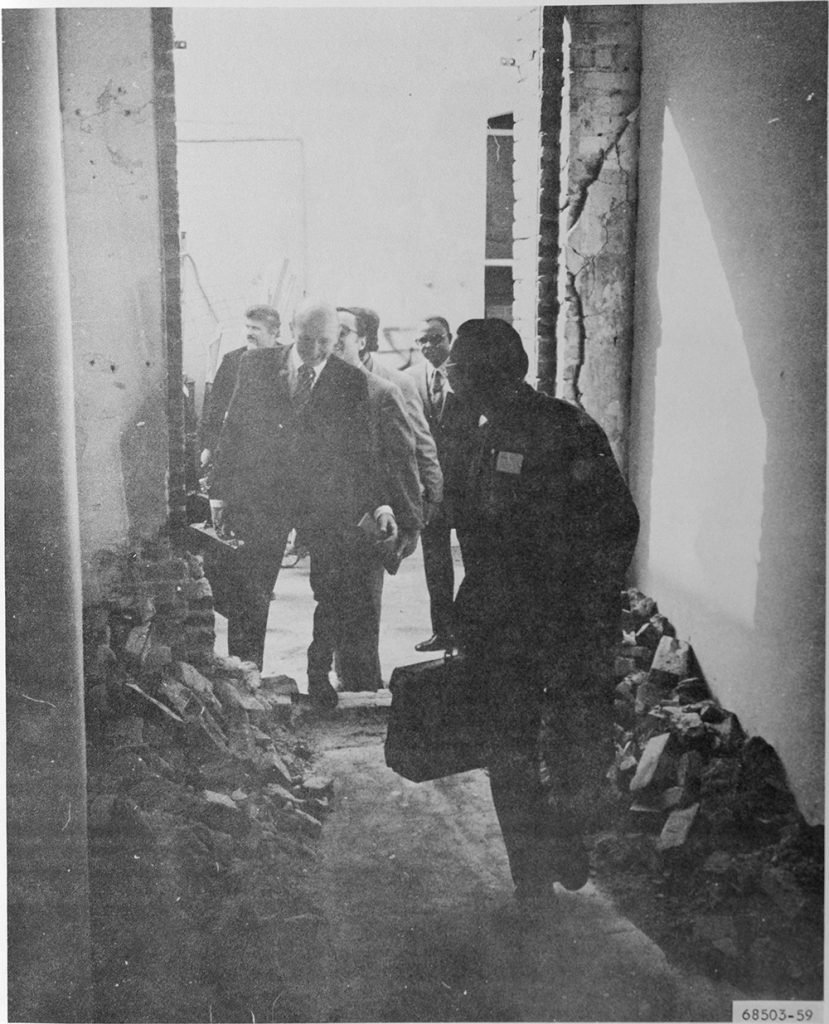
Back alley leading to the opening to Irwin’s studio. Irwin and the freshly made opening
I had them brought to Venice by a circuitous route so that they were completely lost. They drove up an alley, got out of the bus, and there was a hole in the wall. I just knocked it down with a sledgehammer. They went in and they were inside my studio, which felt a little bit like a capsule: no amenities, no outside light, no outside noise. It was also very reverberant, hard to talk.
And they were uncomfortable, really nervous. This is not what they bargained for. This was not a comfortable space. I mean, they went ahead and did what they do, gave their papers. And during the first morning some changes happened. They took off their jackets and did the best they could to accommodate this space. They persevered, because they were professionals.
In the afternoon, they broke up into smaller groups, each discussing some aspect of habitability. I had other artists working with me. We made rooms for those groups. We made a room that was just a little too small, and a little too big, and one that was too reverberant, and one too sound-dampened. Every room had a tactile, physical problem.
I had the outside wall of my studio made out of sonotubes [tubes made of cardboard used in construction], very lightweight so I could easily swing them up. At the end of the first day we removed the tubes and you heard the street of Venice. They still couldn’t see the outside because the front wall was covered with paper, it was open in a sense that it let soft light and sound through, but no visibility. People were like, “What’s going on?”
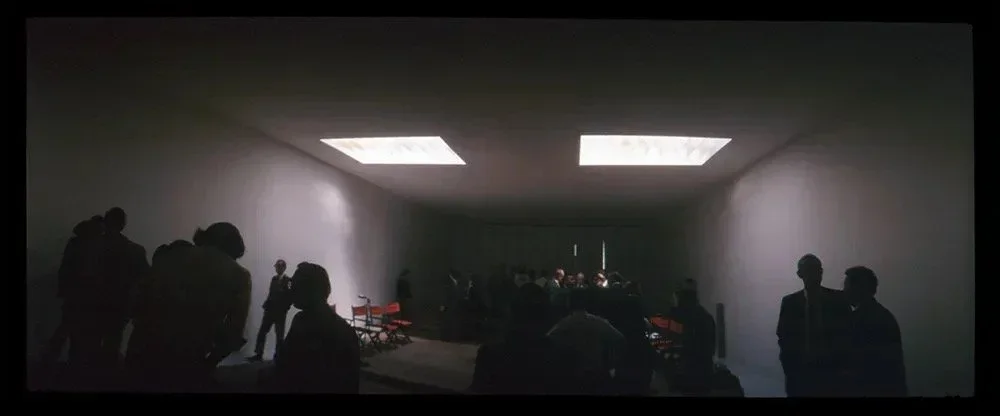
Symposium space on the first day. This and all color photographs below by Larry Bell.
That night I also opened up a couple of skylights, so when they came the second day, there was more light in the room. And they were more relaxed, you could see the change of clothes and habits. People who started out the first day having trouble doing their papers were in a much more accommodating mood, and began to accept the environment.
On the second day, only half of them would go into the breakout rooms. Some said, “No. We’re not going in them. We’ll go out and sit on the beach.” The first day they had been in suits, and on the second day they were sitting on the beach. The environment had begun to change their actions and comforts.
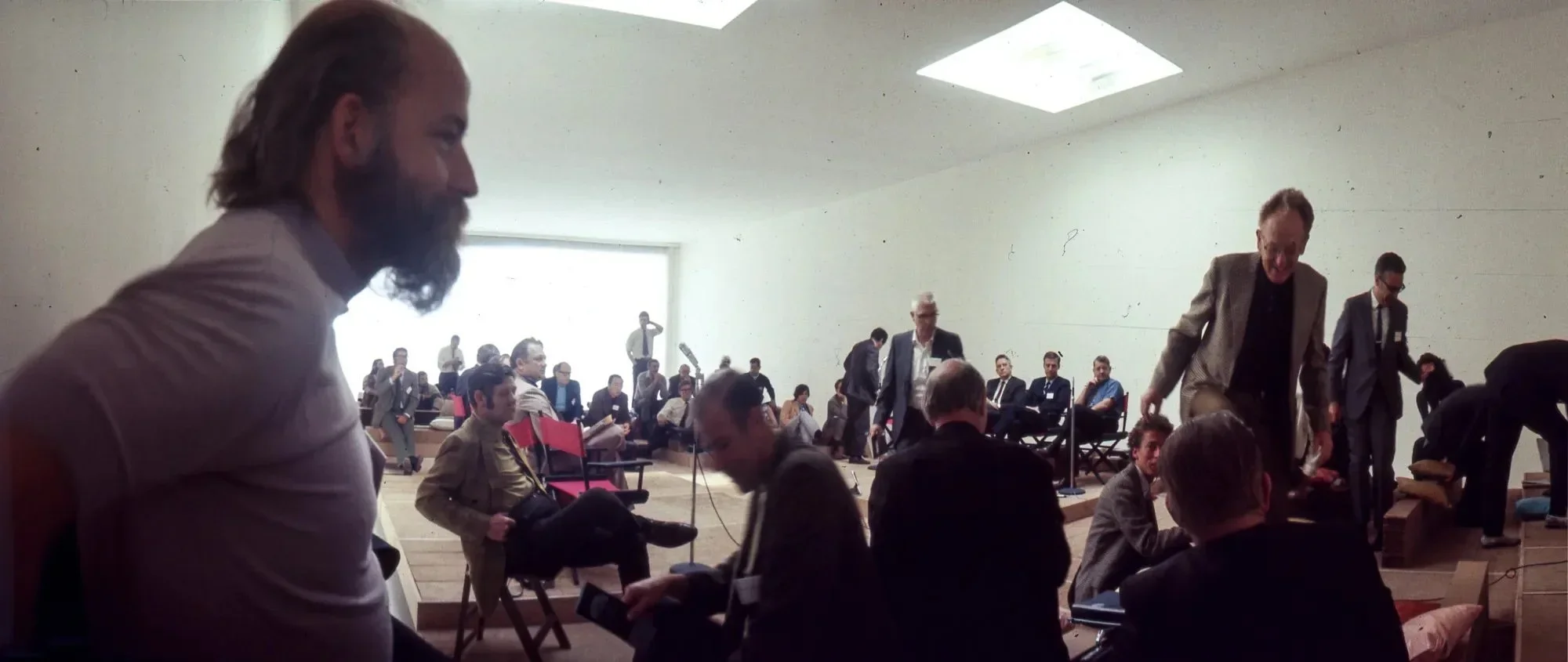
Robert Irwin at his studio, second day of the symposium
Now, they were talking about being in a capsule for how long? Five years out in space? And they were having trouble being in a room on the second day because there was something wrong with it!
At the end of the first session that day I cut the outside wall paper and we walked out right through it. Other artists prepared lunch for them. We tried to make it crunchy and bittersweet, with tactile qualities to the food as well as nutrition. They ate it sitting outdoors on the edge of the curb. People began to intermix rather differently: on the first day they had been staying in disciplinary groups, and on the second day they were beginning to interact across disciplines.
On the third day there was actually no outside wall. People walked by on the street and looked in and wanted to know what was going on. The police came by and wanted to know what was happening. The trash men banged their trash cans as they went by and everybody was peeking in. By the third day, nobody would go into those breakout rooms.
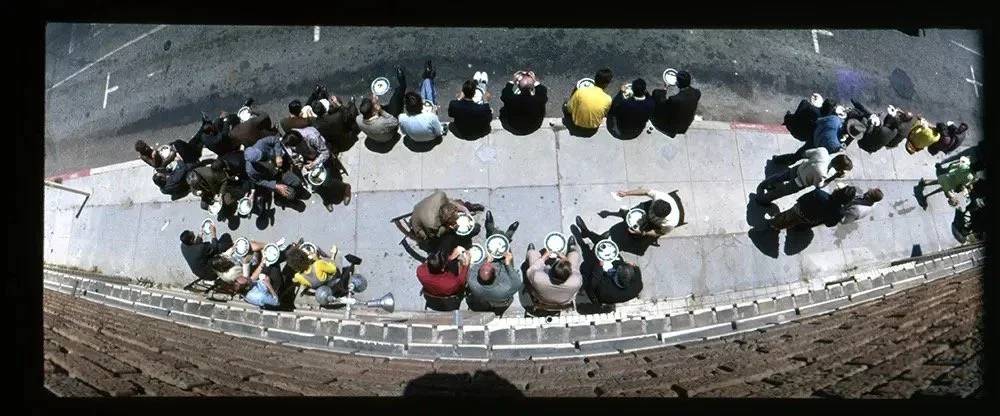
Lunch
On the fourth day, they were supposed to have a summary. Only one person from each discipline was supposed to stay, but many more stayed. Something had happened. And they weren’t sure what. Most of them were, oddly enough, not aware of how much the physicality of the space, the areas they were in, affected their behavior, their clothing, their attitude with each other.
Certain guys tore up their papers and just started speaking ad hoc, addressing what was going on. They were confused about exactly what happened to them, because they’d been fucked over, actually. In terms of their normally being at the Intercontinental in their suits and giving their papers. The place was not a good space. But by the fourth day, nobody wanted to leave. People came from around the world, from Europe and India. And they didn’t want to leave. They were like, “Something’s happening here.”
The symposium was, I think, a pretty big success. It didn’t answer any questions, but it reframed the dialogue.
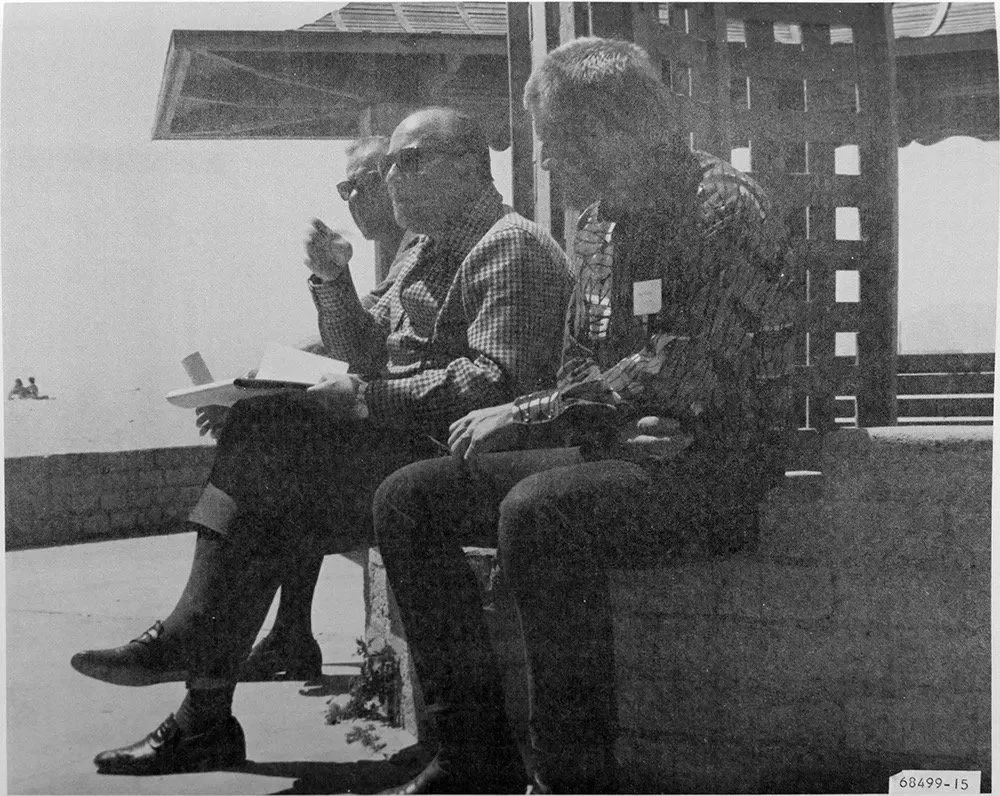
Afternoon session on the beach
BO: What other contributions artists made to the symposium?
RI: Larry Bell had a camera in his hand the whole time. He photographed everything.
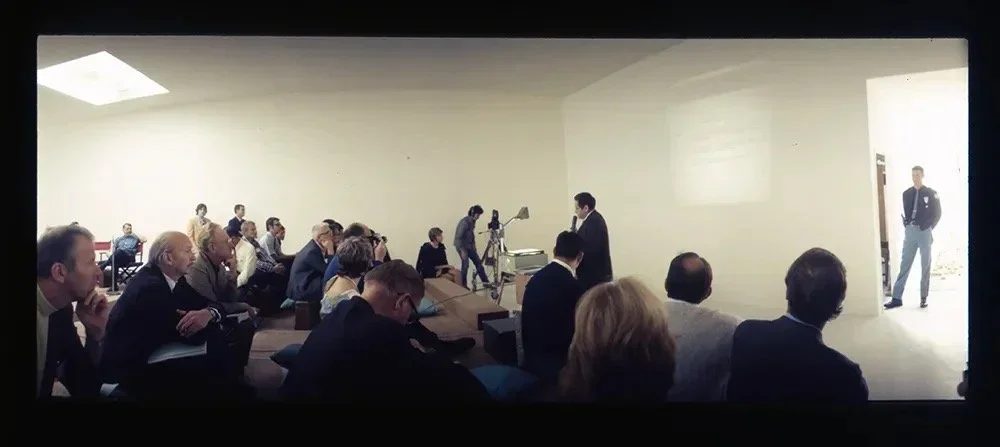
Second or third day. Larry Bell operates the moving image camera by the back wall.
At one point we started making furniture out of the logs that we built for the symposium. Jack Brogan realized that if you sawed them in a curve, they became extremely strong. So he started sawing them up into shapes.
Frank Gehry took the sonotubes idea that we used to make the front of the building and used that same material to do the Hollywood Bowl.
BO: How many people knew what was going to happen?
RI: Nobody. Just Ed Wortz. It was dangerous for him, his reputation was at stake.
BO: If they knew at NASA, would they have let it happen? Or would they have shut it down?
RI: I have no idea what they would have done. Ed Wortz was the man who put his reputation on the line. He was willing to roll the dice with me.
BO: So it was a guerrilla action.
RI: I guess so. I never thought of it in those terms. I didn’t know that it was going to work as well as it did. And at moments it looked like it was going to backfire. Ed was willing to go along with the thing, but I don’t think even he quite knew, except that the symposium was gonna be not about ideas but about how things feel.
I thought, you’re here to talk about what’s it going to be like in a capsule? What are the issues with surfaces, sounds? These things are about experience, they are not calculus. It’s a qualitative problem. So I switched the conversation to a qualitative domain.
In a sense, we destroyed the symposium because people started talking about, “Why are we feeling this way?”, and began to discuss the quality of being within a capsule. They started talking about what it felt, how much they were affected by spaces. Which was not a thing they as scientists normally considered. But, as an artist, I was more involved with that kind of problem than they were. It was a problem I was living with. So I presented it to them because it was gonna be a problem they were gonna deal with.
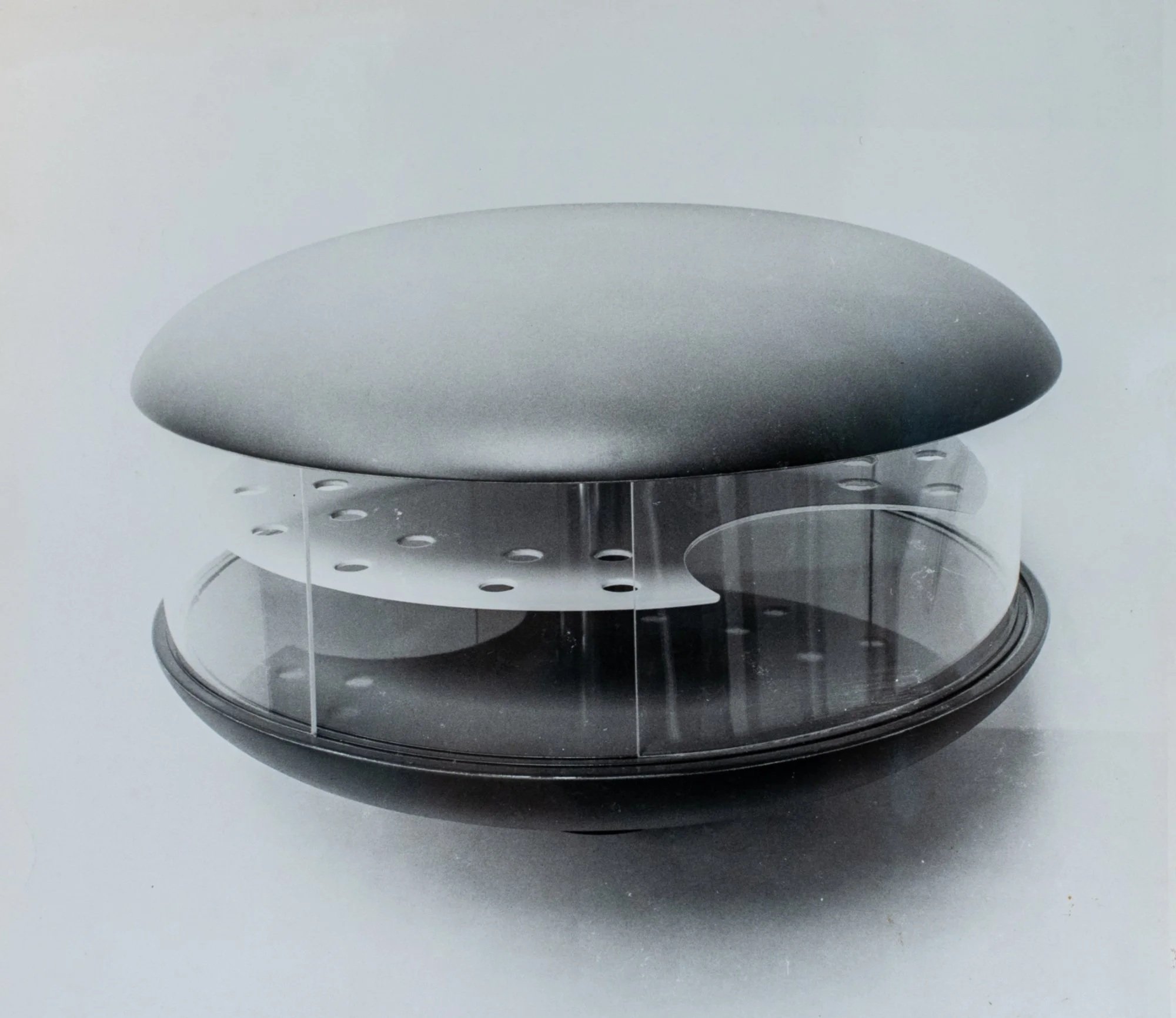
Maquette of a microwave oven designed by Irwin for NASA, fabricated by Jack Brogan.
BO: Why was it important for you to present it to them?
RI: You just can’t approach the subject with the tools that they were using. What they were using was words. Propositions that were intellectual but not physical, not tactile. You’re putting a guy in a capsule, what’s he gonna experience? How will he understand this thing, process it? What will become the issues? As an astronaut, you have a job and you’re doing it, that’s what you’re holding on to. Your sanity is connected to your job and you persevere. But for how long? At what point does this thing begin to close in on you?
Few people apparently had gotten into issues of what it was gonna feel like. And there they were. They called it habitability. So I gave them an exercise in habitability.
BO: You were also working on these questions outside of the symposium, right?
RI: We borrowed a sound-dampened space at UCLA, their anechoic chamber. We were put in blindfold. Had somebody else put us in. And we had a button “Get me out of here.” I spent as much as five, six hours inside. Even more on a couple of occasions. And when you came out, sometimes nobody was there. You just had to walk through the campus to your car to go. No human interaction.
Most startling things happened: the entire world became animated. Trees, of course, leaves. Houses didn’t stand still either. Not in any comic sense, but they had an energy to them, an emanation, everything did. Everything was acting on and interacting with everything else.
Those anechoic chamber experiments really focused me on the idea of what is the subject of art. The way I understood the symposium, and the art, it was not about informing people. It was an inquiry, a way of looking at the world. What I wanted to do is to change the way people who came to the Symposium were looking at the world. What does the world mean to us? How do we absorb it, act on it, function in it? How it affects us, makes us, redefines us?
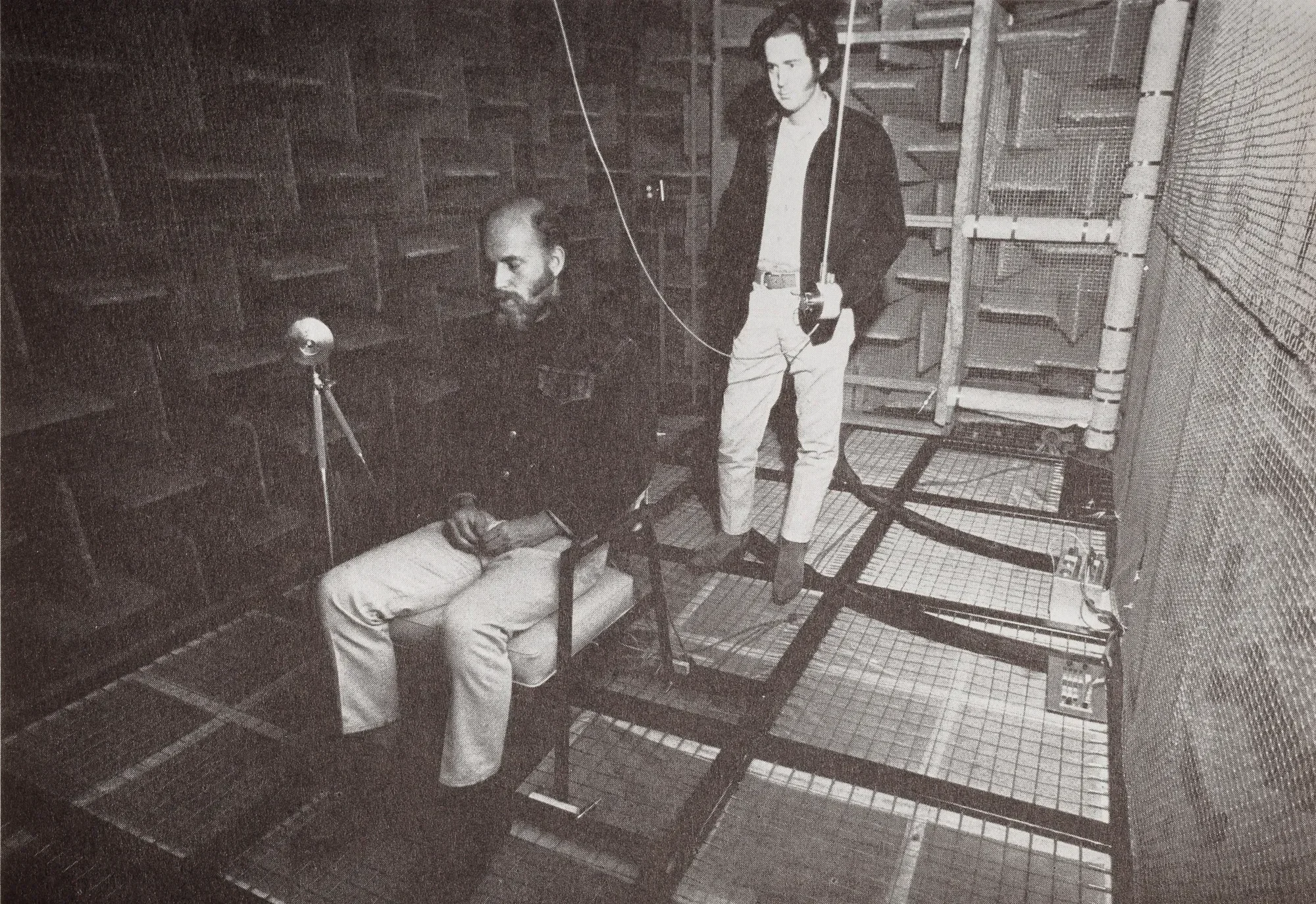
Robert Irwin and James Turrell in the UCLA anechoic chamber. Photograph by Malcolm Lubliner
And at what point the old tools become a trap?
In the 20 years before that project I took painting apart and threw it away, because the idea that you can put all the ideas about what is being an artist into a frame with gold leaf on the side and hang it on a wall became ridiculous to me. So I created a painting that didn’t begin and end at the edge, and then eliminated the painting altogether and started finding ways to move through the world.
To a great degree, the way art is practiced is like those guys on the first day of the symposium, when they came in their suits: they had a frame around their subject. But on what grounds do you make that frame?
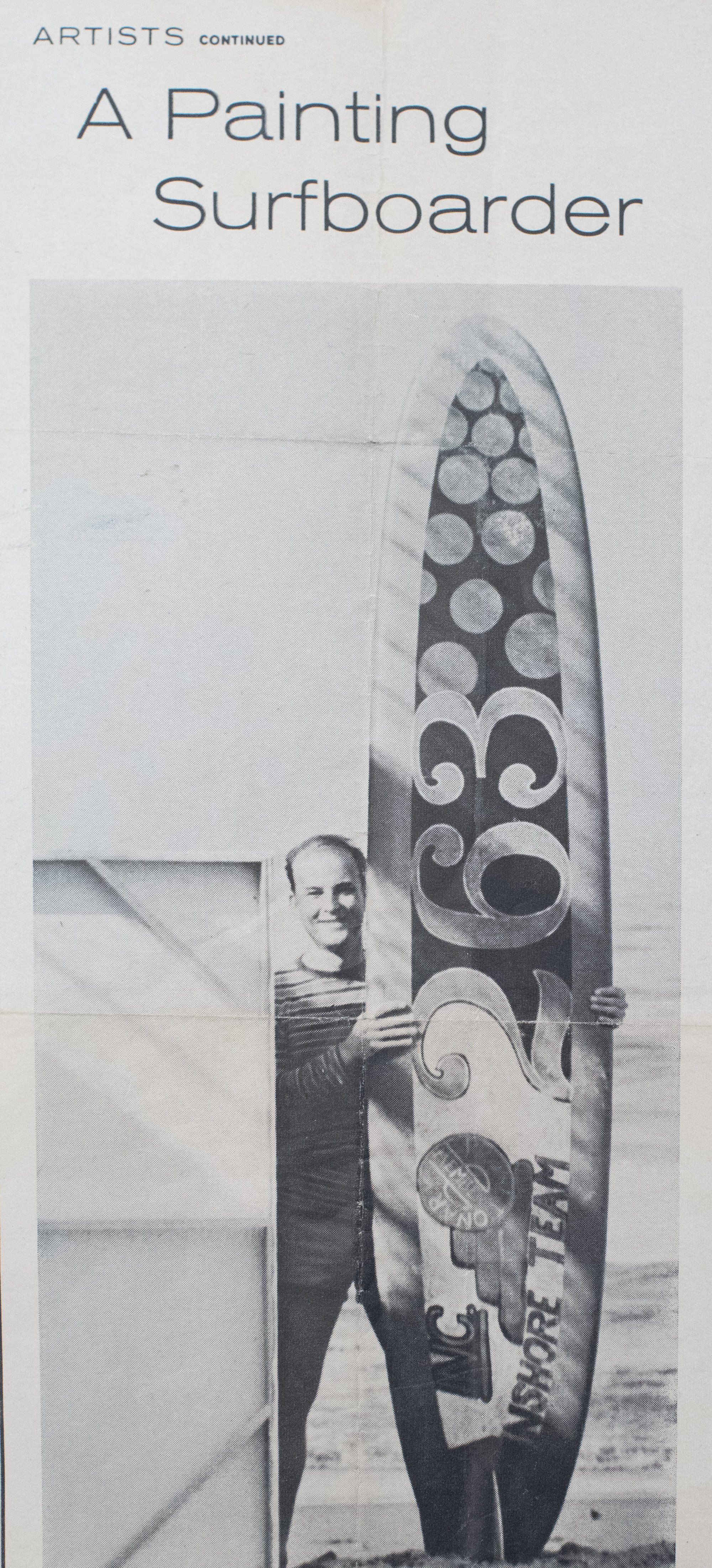
Irwin, Life magazine, 1962
I grew up in LA and it was the most fun in the world. I was swing dancing, I danced every night. I was a lifeguard on Catalina Island and Lake Arrowhead. I had a great youth. I never went to classes, never went to college. Having too much fun. But at one point, I had to sit down and teach myself philosophy and read every day all day, which was totally antithetical to everything I was.
BO: I saw boxes of your reading notes at the Getty, several boxes worth.
RI: I worked hard at it, because without doing that, I’d never have been an artist.
And when you look at it, in the history of art of the last 100, 150 years, you start out with David, doing incredibly beautiful paintings, and in a 100 years you end up with Malevich. Malevich painted what he did, looked at it and said, “My God, everything we know and love is gone. It’s a desert. But it’s a desert of pure feeling!”
You put all this together and see that, in the history of the 19th century, the art was doing what I did in that symposium: took away the staples that disciplines were based on. What I had done with NASA was done to art. Responsibility now becomes: how do we organize art as a discipline, as a way of knowing? That’s a big problem for me. Every now and then I do a project which hopefully makes this point.
BO: For the past few days, I was sitting in the Getty and LACMA archives researching the Symposium, and it turns out there’s very little material left. Do you know why?
RI: Because the symposium was done in the science world. LACMA never did a show about it. They did a show of all the winking, blinking things that were made in the Art and Technology project, but not the Symposium.
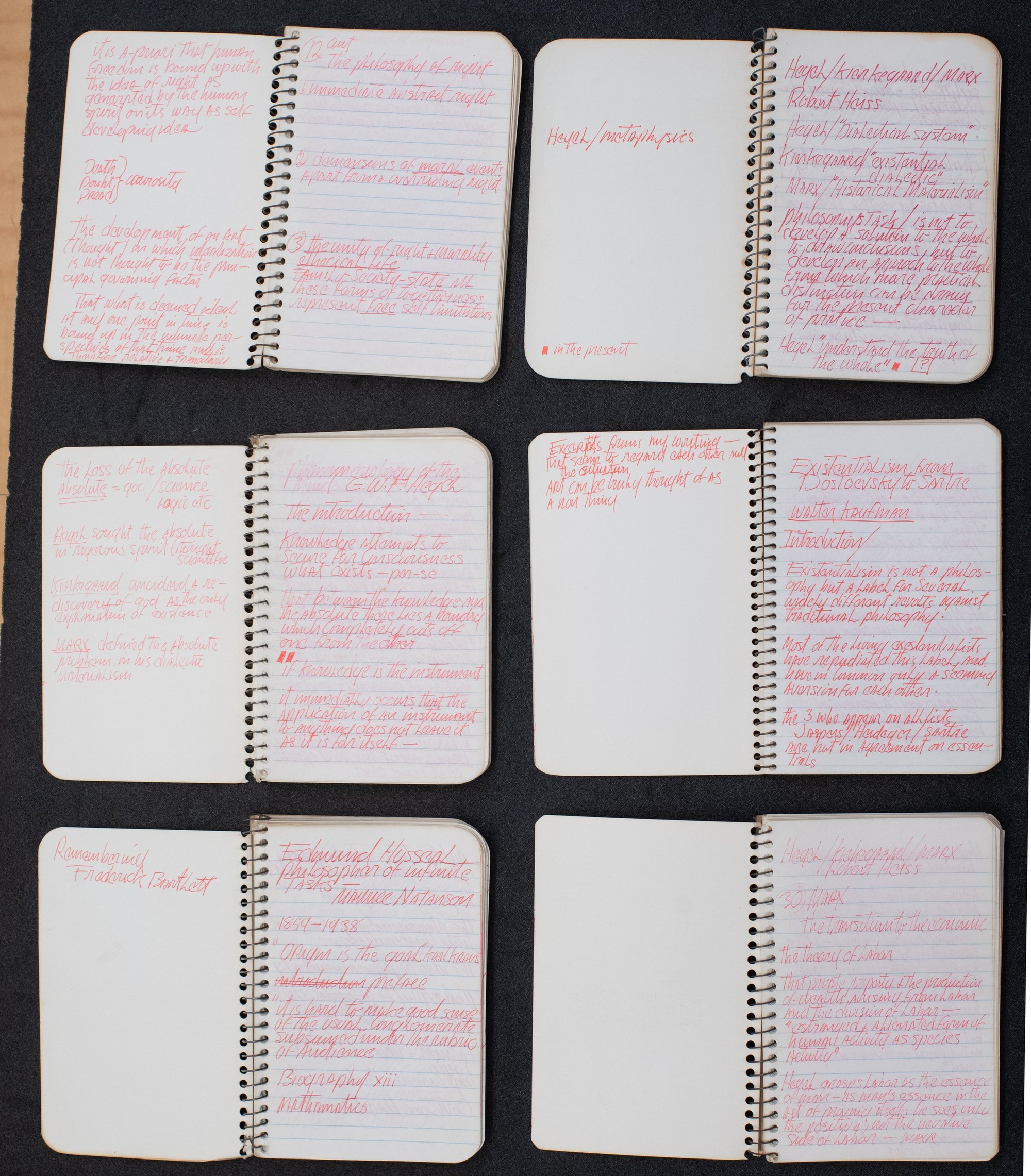
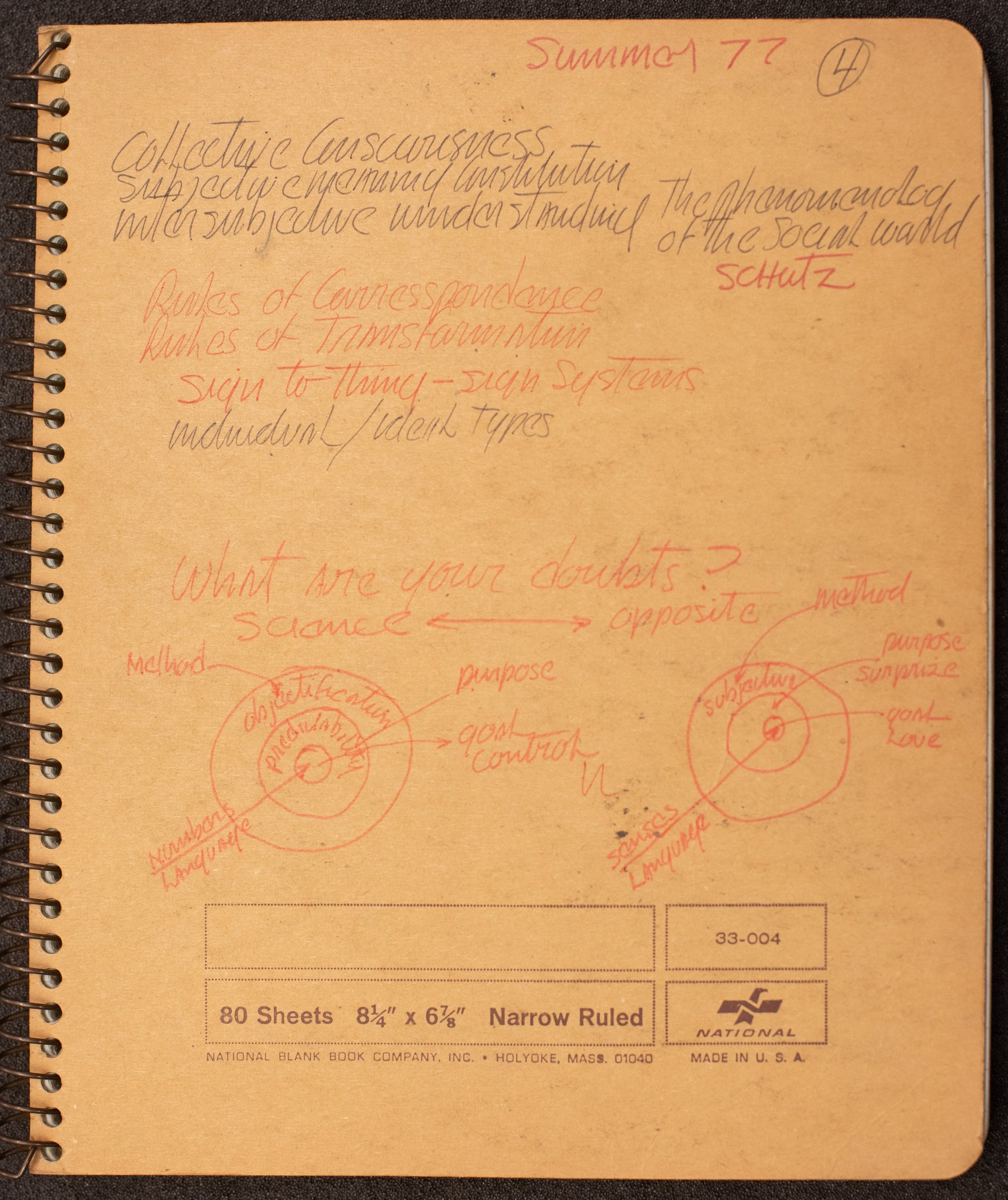
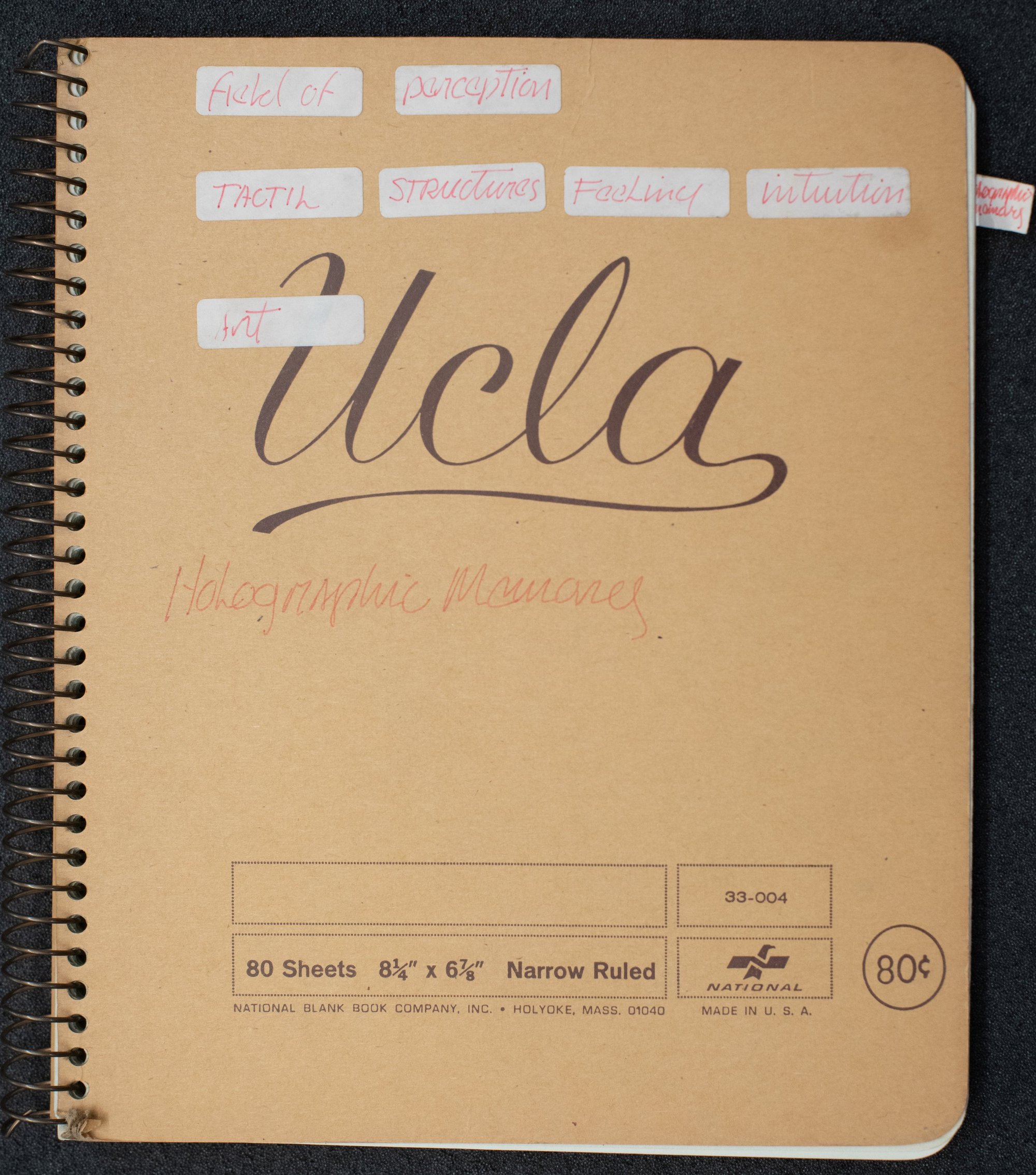
Irwin’s notebooks. Getty Research Institute Archives
BO: How would you imagine a show about the symposium, if you were to do one?
RI: That would take some thought. I would say that it should have the character of the symposium. You have to ask: What kind of space do I have? How will people arrive? Where do they come from? What distance do they walk? Where do they park? What time of the year is it? What are their expectations? And how do you deal with those expectations and not give them what they think they’re gonna see.
You gotta answer these questions. Do you have a space that has the needed flexibility? Because most museums are pretty rigid. So maybe you’re better off in a warehouse so you can move things around.
BO: Are you saying: one should make the museum less of a museum to make this exhibition work?
RI: Yeah. When people come to a museum, they’re already presupposed to see certain things in a certain way. The first thing you do is break that habit.
BO: One thing I found in LACMA’s archive was your interview with Frederick Wight for the UCLA Oral History Collection.
RI: It was a good interview. He was very, very curious about what was going on in the arts.
BO: One of the questions he asked you was, “What is the difference between an art historian and an artist?” And you answered that art historians look at similarities, how things evolve from one to another. Artists, on the other hand, look at differences, things that stick out, that don’t fit. Do you still think the same way?
RI: Well, that’s a little too simplified. I guess, in a general sense, we’re responsible for the sentient world. And historians are concerned with the cognitive world. So, we gather entirely different kinds of information. We work with an entirely different set of means.
But today, I feel that the art world has been compromised in so many ways. It doesn’t deal with big issues anymore. Not that good artists don’t do good things, but…
The idea of an art fair is so fucking far away from anything that has any validity whatsoever. That we can put something on a temporary wall with temporary lighting with hundreds of people going through, and it’s just… It’s abominable. We’ve failed.
I’ve never been to an art fair. I won’t go in. I don’t want to know about it. As far as I’m concerned, it has nothing to do with anything I’m interested in.
I have a piece right now [2018] in a gallery right across the street from LACMA. The space is in an office building that actually had beautiful light. But the first thing the gallery did when they rented it was put up walls, so they can hang paintings. They immediately eliminated the most beautiful thing about the space. That tells you the state of art right now. And the worst thing is they don’t even know their own history.
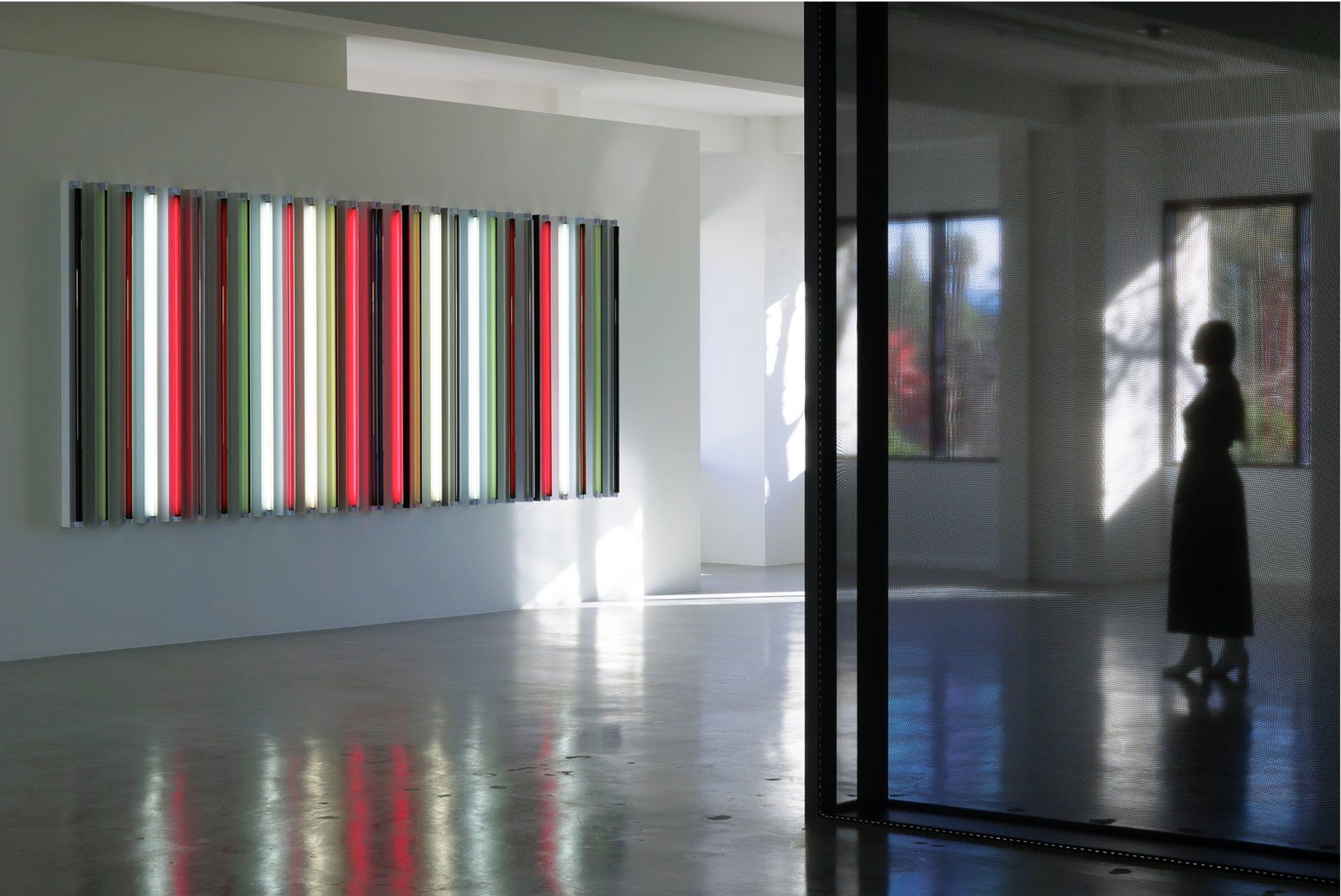
Installation view, Sprüth Magers Los Angeles, 2018
I don’t even know how to deal with it other than laugh because it’s pretty funny the way the world gives you a middle finger. Bizarre.
BO: How would you fix it?
RI: Fixing that is an economic problem. It’s mercantile. Art is not anymore a line of inquiry, not a question, not an interest in the ‘what’ and the ‘why’ of anything. It’s all about making money.
BO: That’s a political statement.
RI: Might be. But I don’t dwell on it. Ad Reinhardt said it best, “Art is art and everything else is everything else.”
BO: Have you ever thought about the Symposium as a political action?
RI: It was more about science, it was not about art. It was science, but they had wandered into our area. You know what I mean? I was more prepared to deal with their problem than they were. They were dealing with a problem that was antithetical to their methodology. So what I did is experientially make them do something they don’t normally do, which is to act as a sentient being for whom feelings are tantamount to ideas. That has political ramifications.
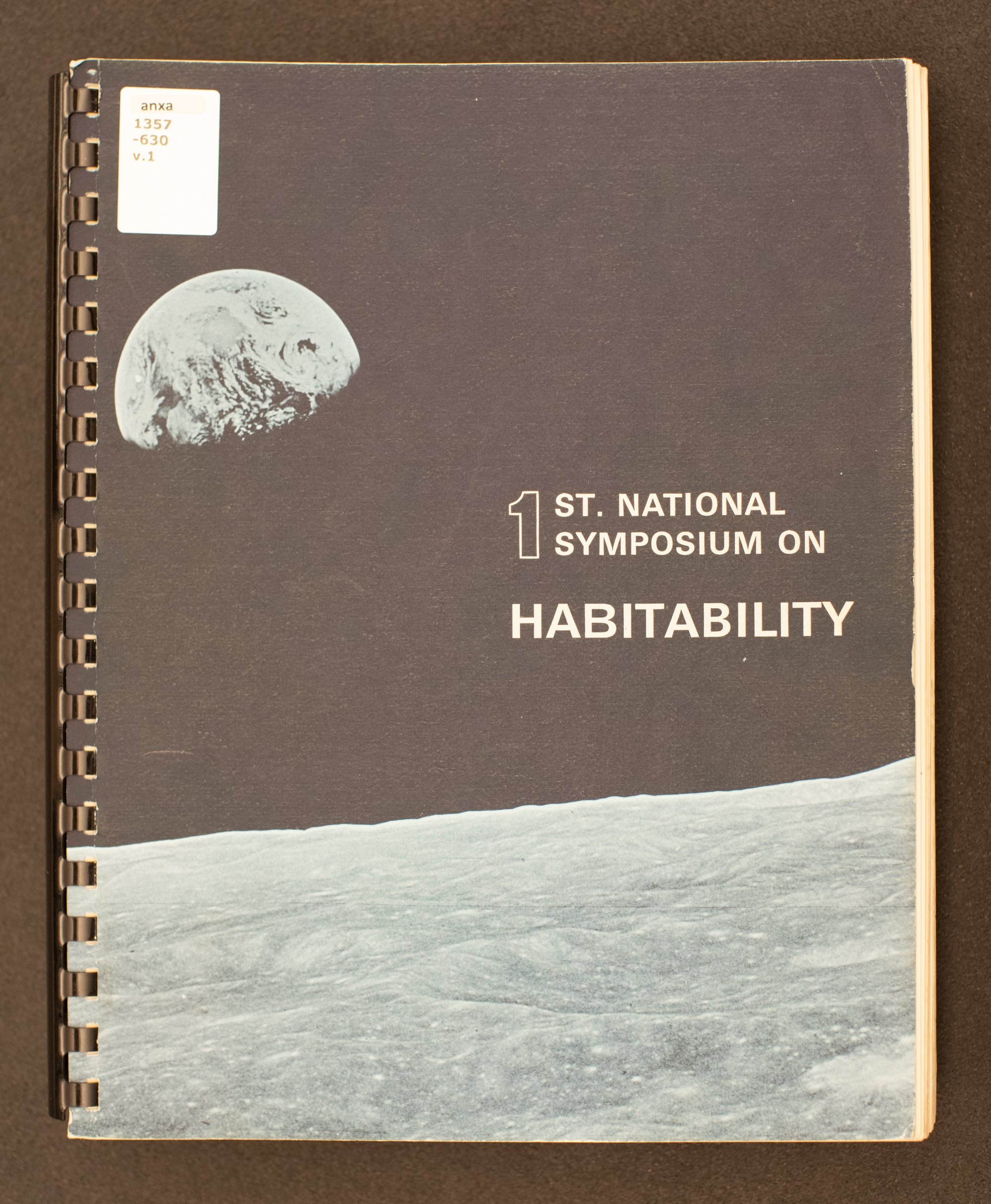
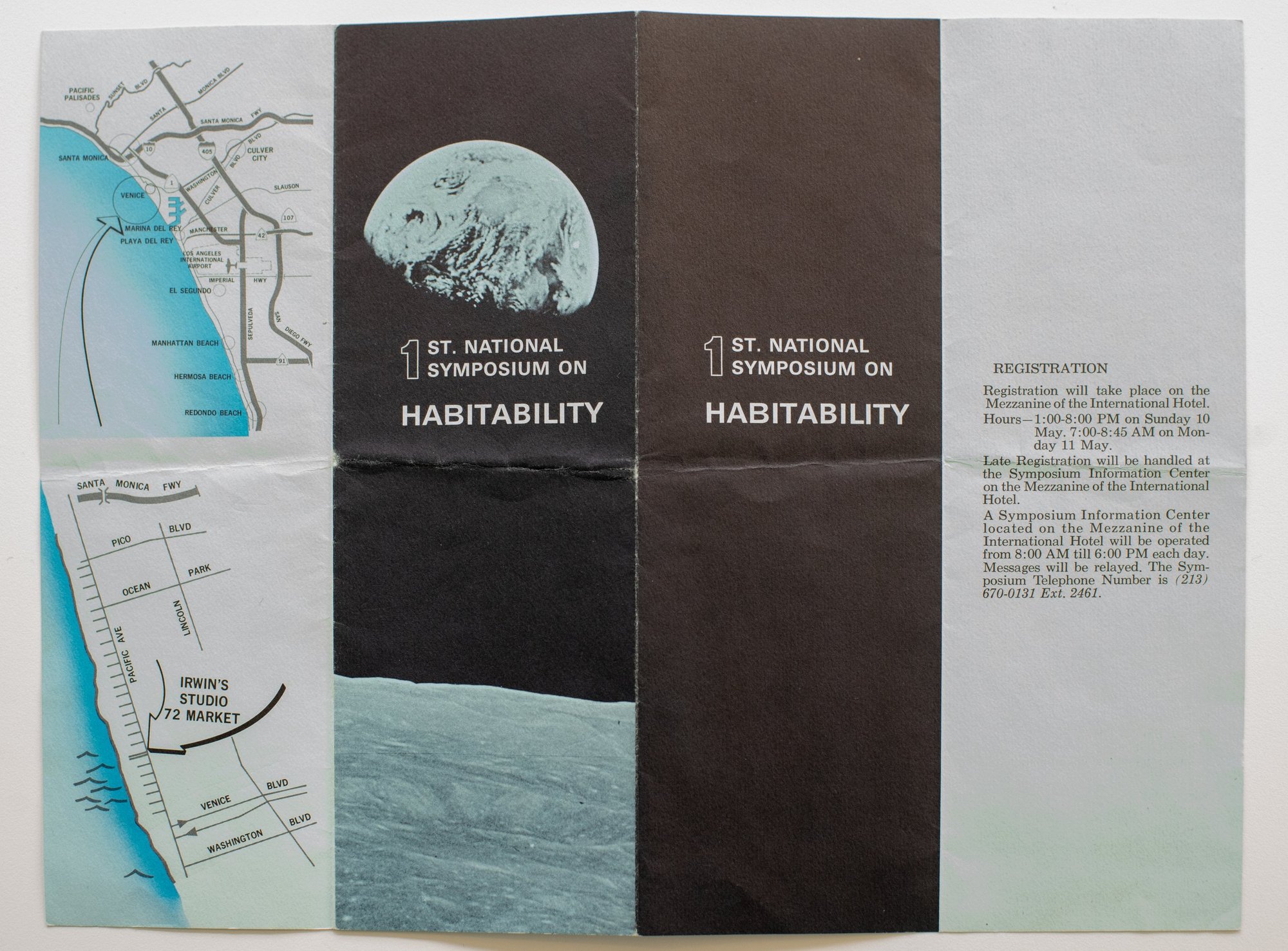
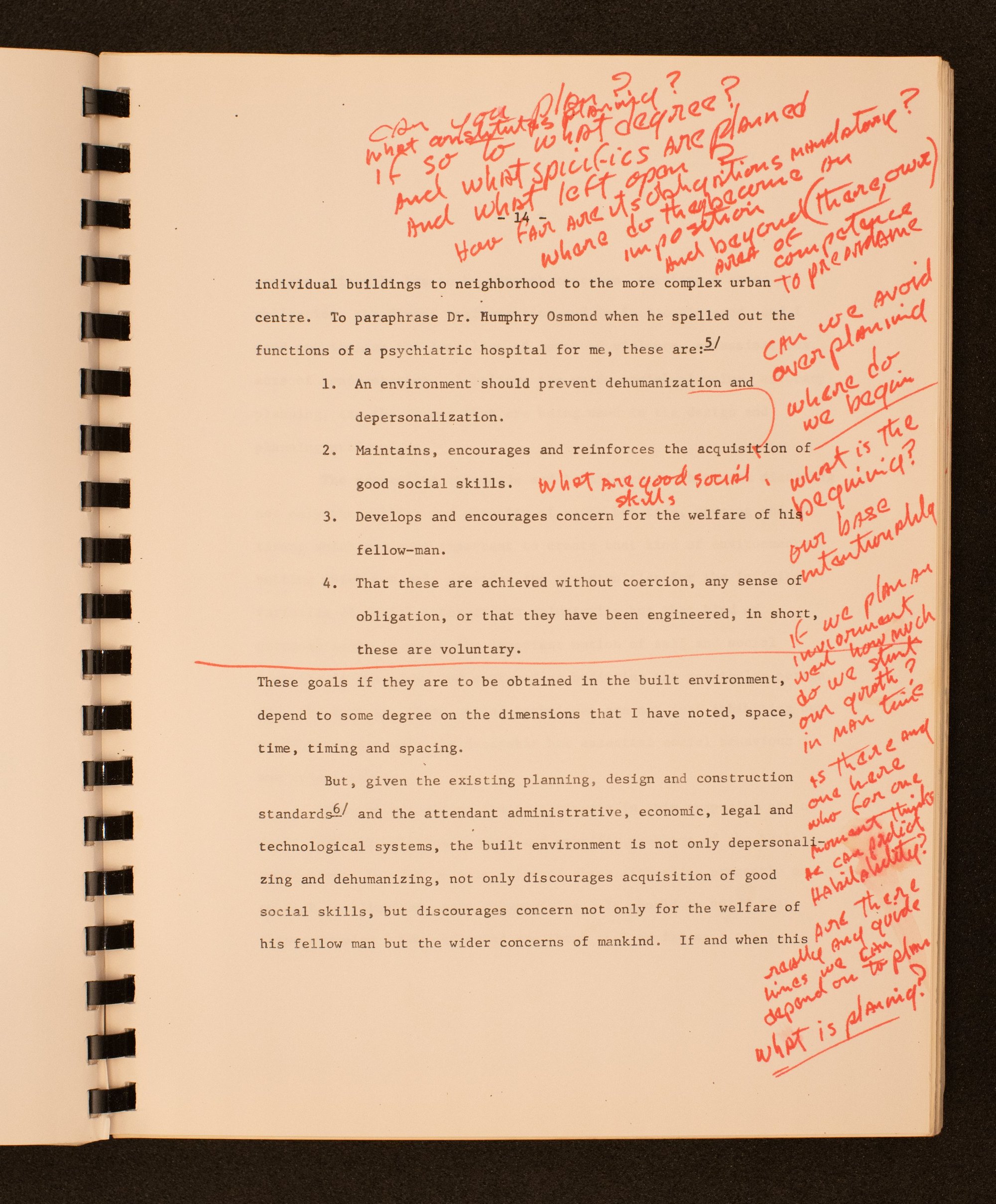
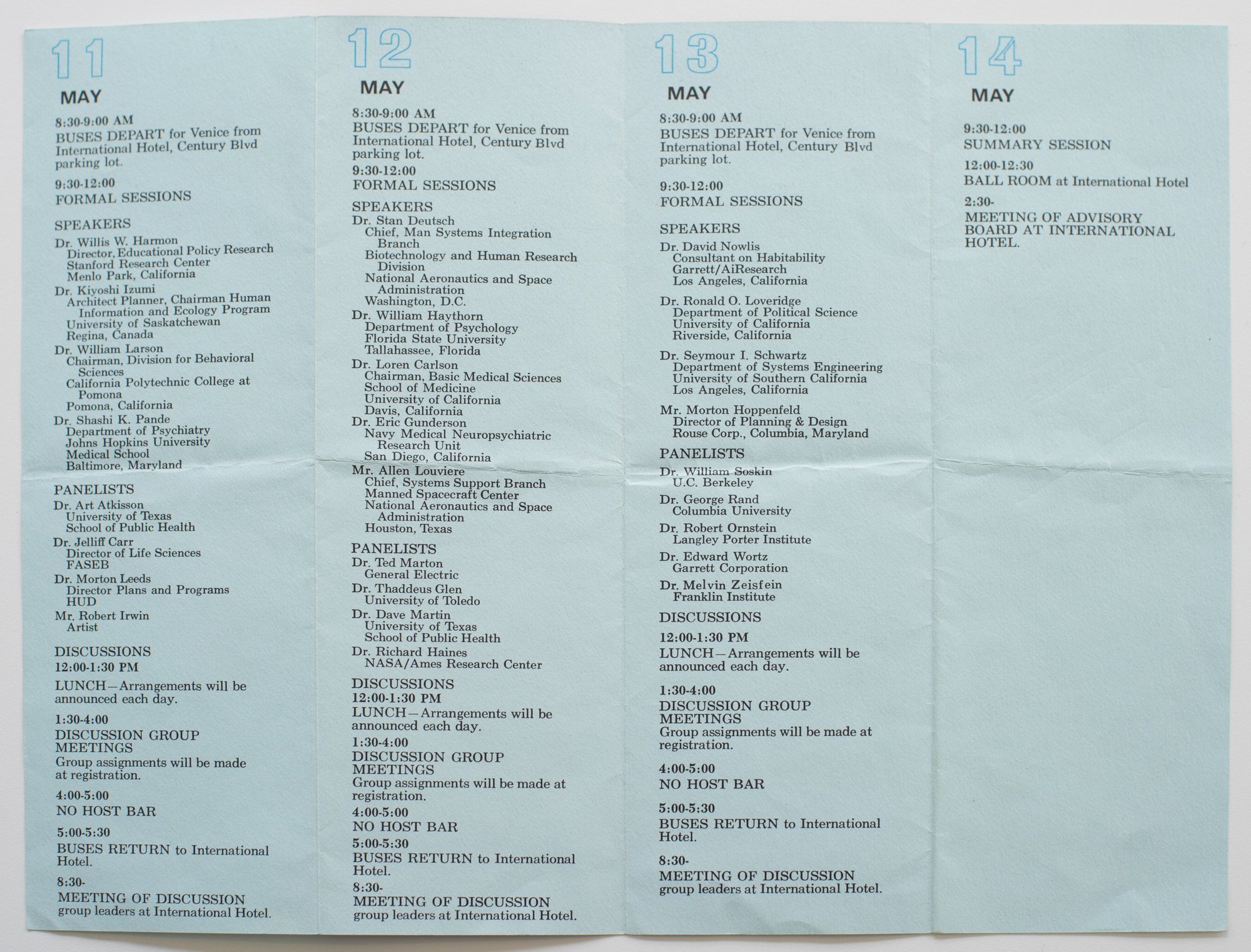
Printed materials from the symposium with Irwin’s notes
BO: After that you did other political works.
RI: I was still teaching at Irvine at that time. I had these two students, Josh Young and Chris Burden.
Josh Young was literally sitting in a tree smoking pot when I first met him… He came down and we talked.
He was interested in ethnomethodology. It’s a way for a community to define itself rather than being defined by somebody on the outside. We started out and asked a few people, “Who are the artists? Give me five names.” And then I go to those five and say, “Who are the artists?” And they name ten more.
And you keep asking, “Who are the artists?” until it creates a community. Levels of interest and practice. At some point, this thing starts having hierarchies.
The women at that time were being very political. Judy Chicago. Miriam Schapiro. They didn’t want to play. They thought as males, we were going to exploit them again in some way. But we got them to participate. They came up as a solid block. Which told me right away: this thing works. They were not themselves as a group of artists. They were mainly themselves as independent women. So it was a real test of the methodology.
That led to the Market Street Project. We used my studio, did a series of exhibitions.
BO: Today they call this “social networks”. Were those good exhibitions?
RI: There was some good stuff in there. You’re not really looking at the art, you’re saying, “Here’s a group that’s becoming dynamic, having interesting interactions, they’re connecting in a meaningful way.” You don’t know who they are or what their work is, but it’s actually more meaningful than when you curate with an abstract idea in mind. I was fascinated by this, so I turned my whole studio over to Josh. The project had interesting implications, but you couldn’t make a dime on it.
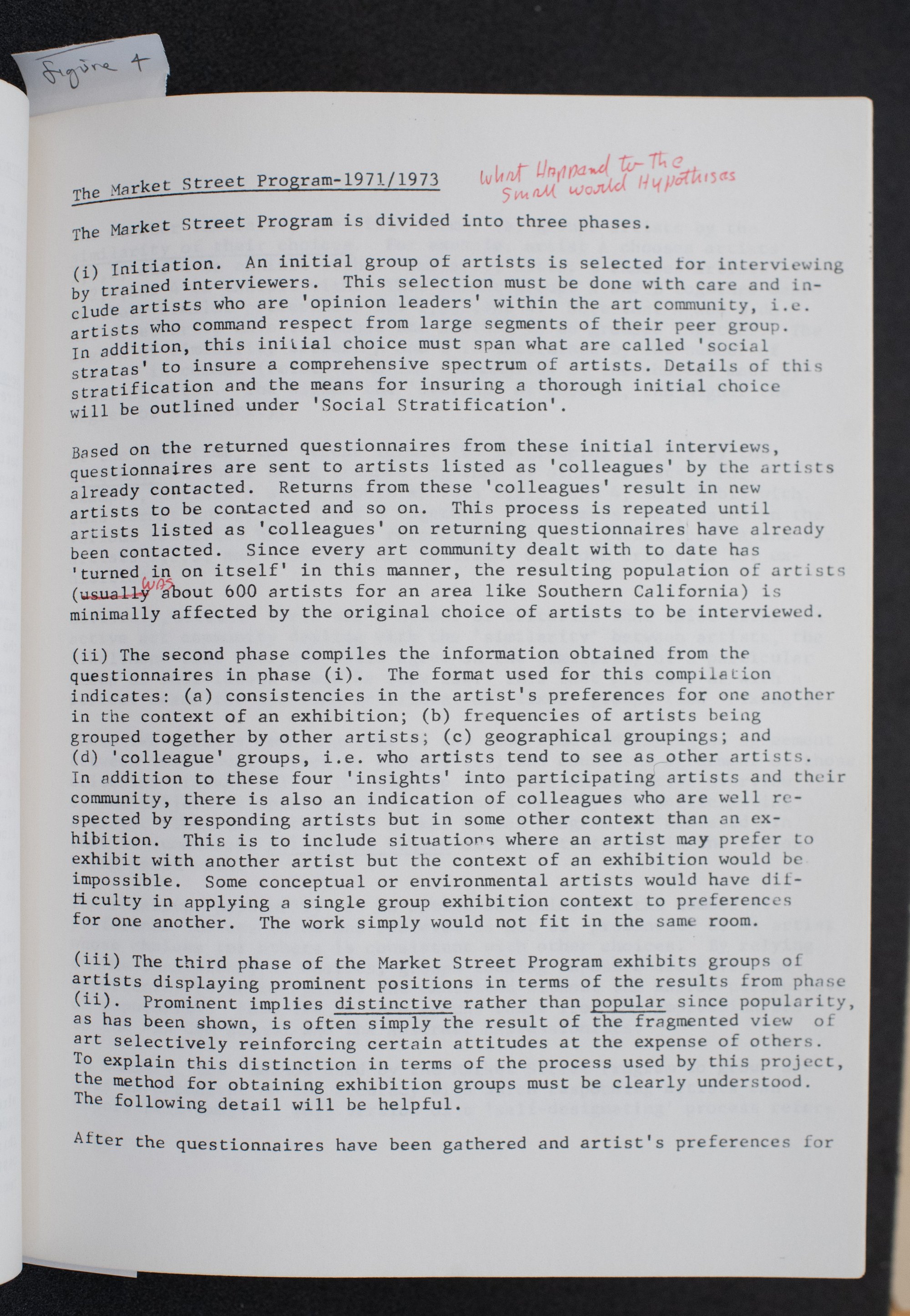
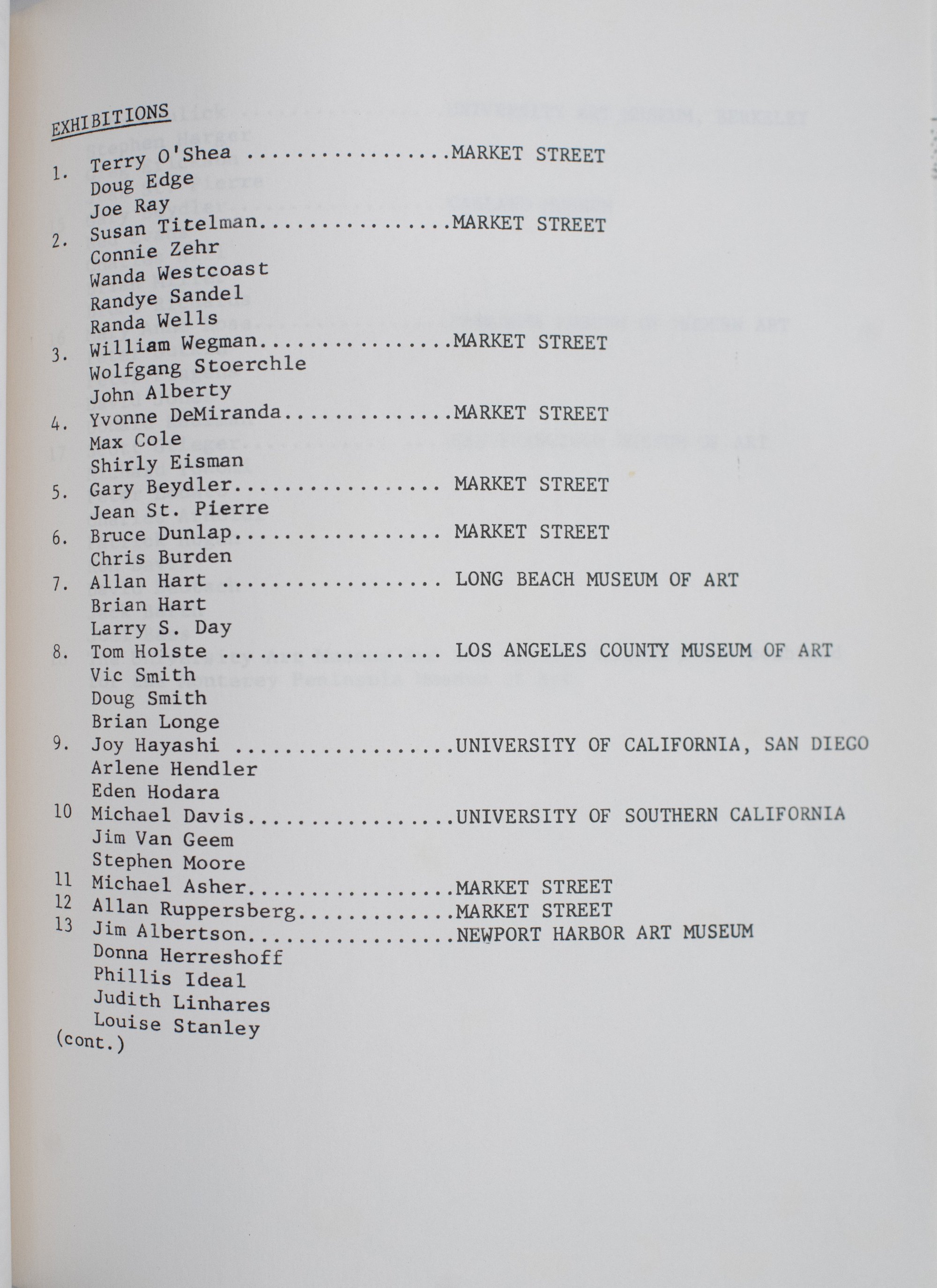
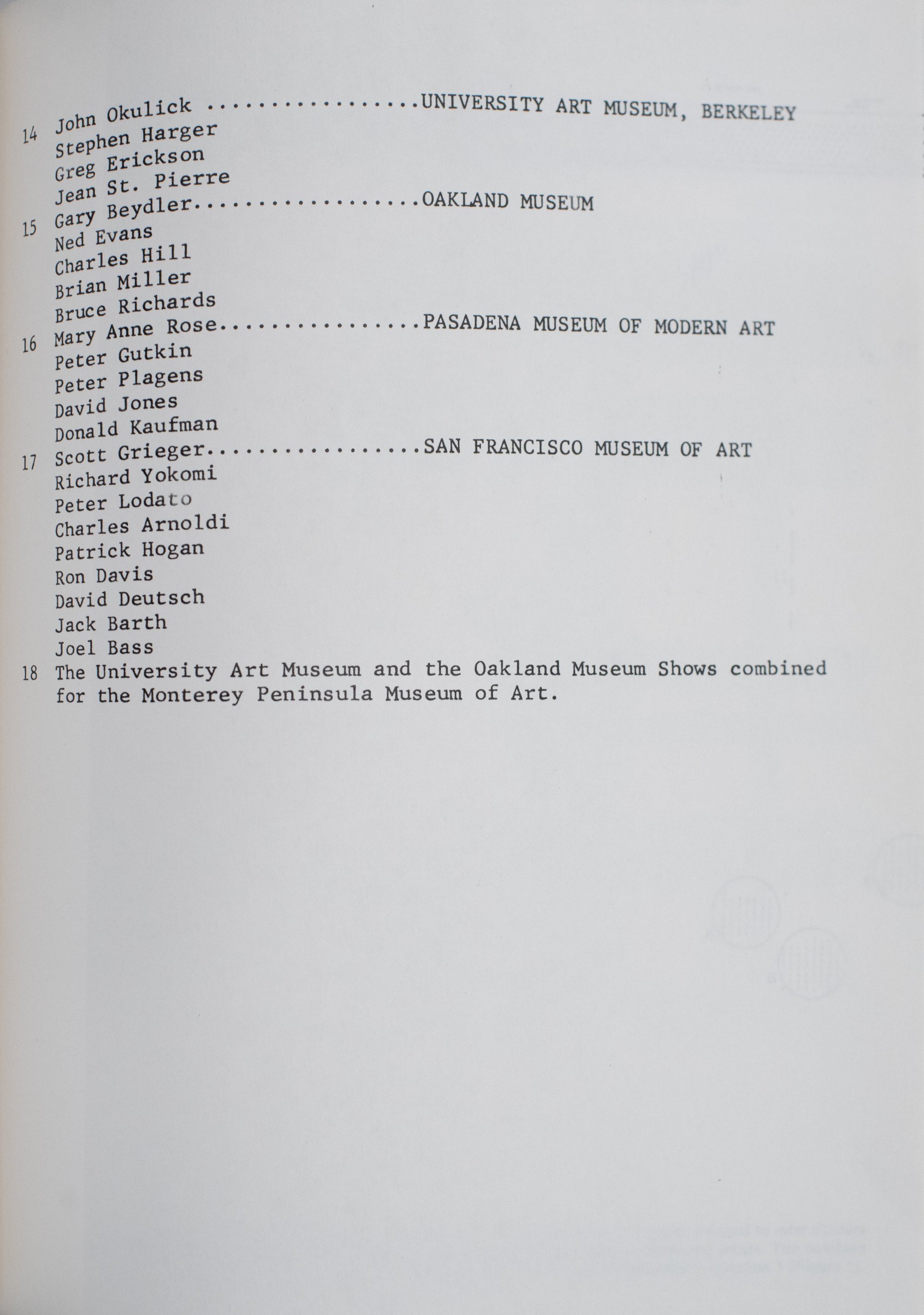
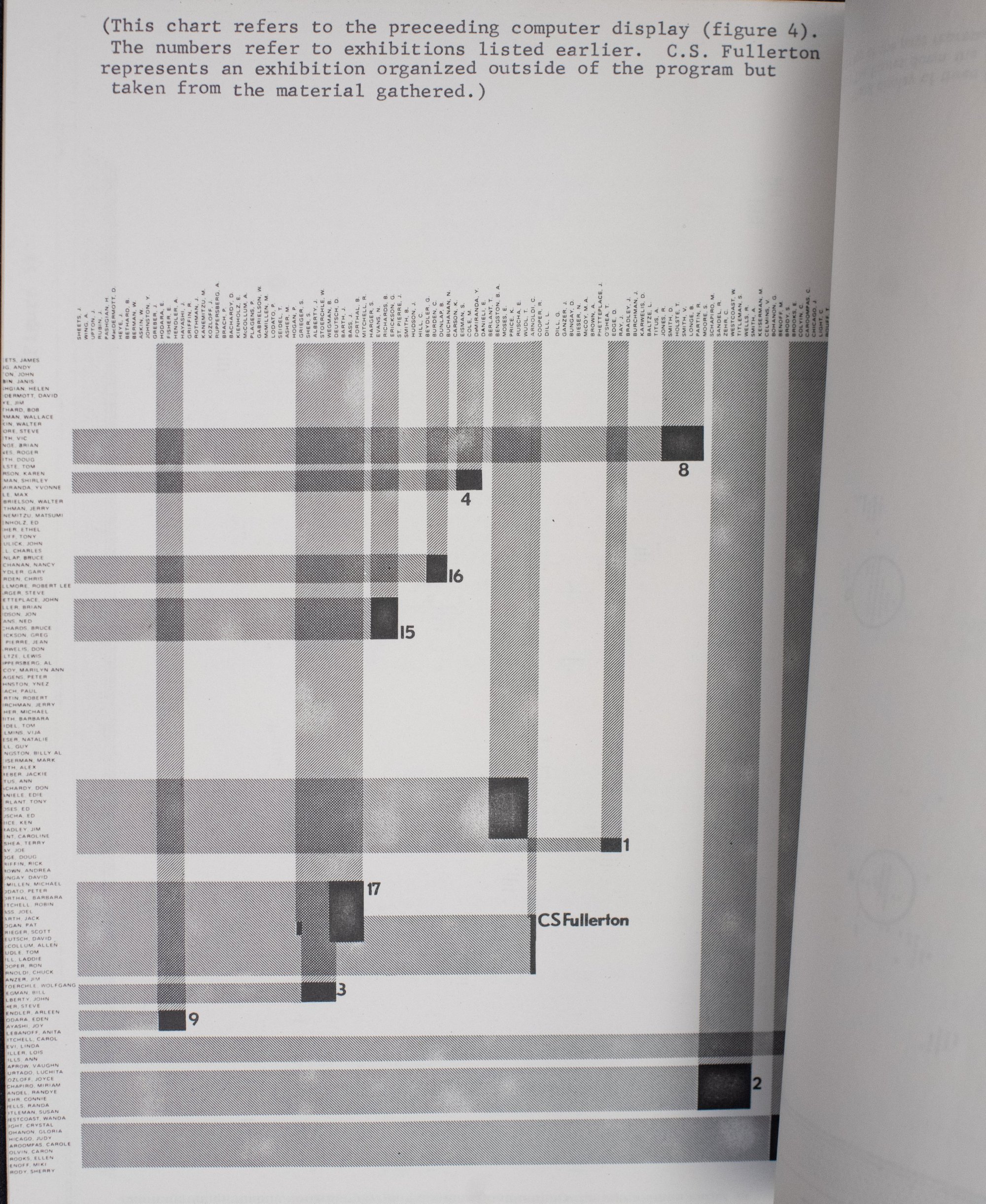
Report on the Market Street Program 1971-1973
The other guy was Chris Burden. For his final project, he filled a gallery with water, set ladders in it, and convinced people to get up on top of the ladders. And when they’re up there, he took a power line and threw it in the water. And then shut the lights off and left. They sat there all night long.
I had to very quickly observe what this guy’s doing. Is there anything meaningful there? Is there any kind of cohesion? I had to know that somebody shut that power line off. It was live when it went in, but it was over with right away. My responsibility was overwhelming. I had to know and I can tell you this guy knew what he was doing. Chris was not crazy. Everything always was carefully, carefully planned.
When time came, they didn’t want to graduate him. I had to go in and have a dialogue with fifteen guys who represented Irvine university, and they said, “This guy’s crazy. He’s dangerous.” They wanted me to justify graduating him.
I said, “The first thing you have to know: everything you’re saying is true.” And if you’re the instructor and this guy comes into your room, the first thing you have to know is: is he crazy? Is he dangerous? And I can tell you, this guy knows what he’s doing. In the end, they graduated him.
There’s a photograph of the two of us. He looks like this little angel and I look like a fucking wild man.
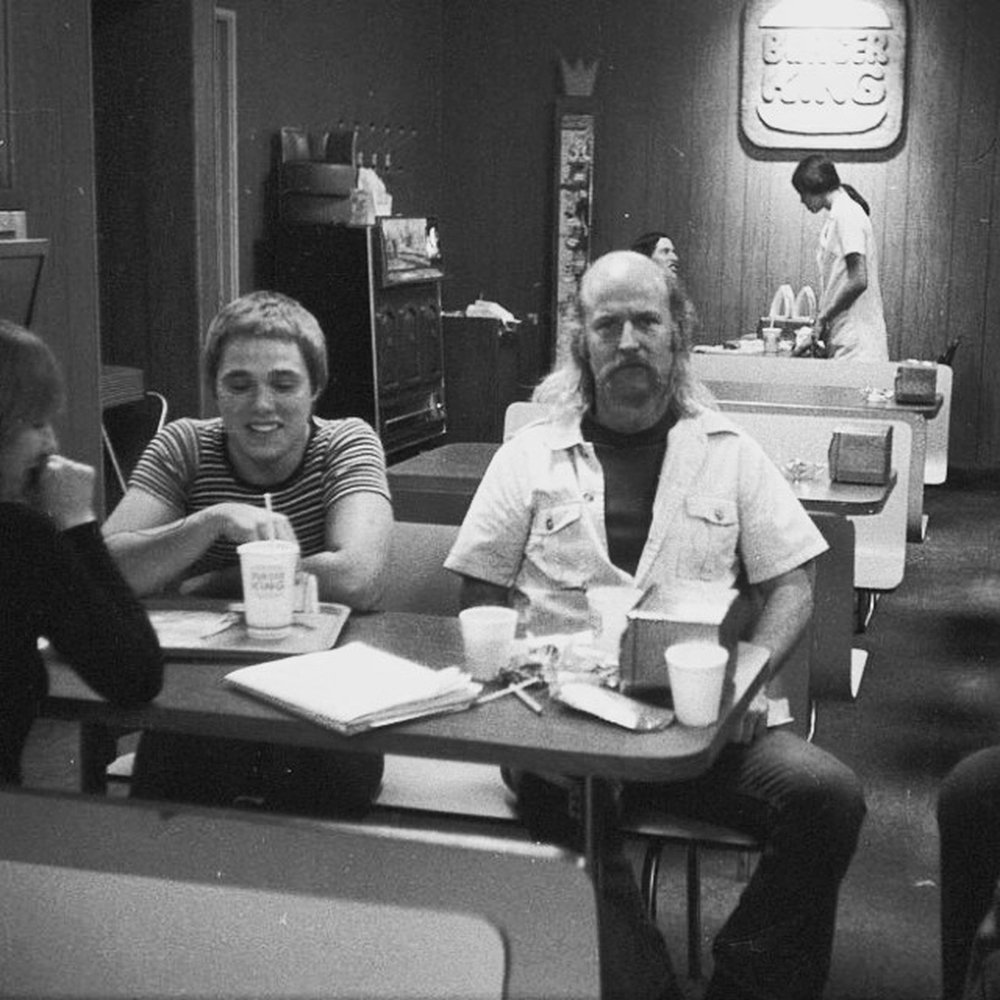
Irwin and Burden, early 1970s
I didn’t teach those two, I just worked with them, spent time with them, asked them questions, pushed them, Why? What? When? Where?
But I do like teaching. I have, by invitation, spent time in every state in the union except two. Somebody asked me to come to a university and I would go. I never ask why, I never ask for the pay. I would go and give a lecture, and then I would answer no questions, but I’d say I will be on the corner tomorrow all day, for as long as somebody’s coming.
I did that in every state, because it’s a very, very important thing to do. It’s not about giving a lecture. You give the lecture to start the dance, where everybody expects you. But then by the second day, you’re down on the same level.
We’re covering a lot of ground here!
BO: I think it’s all connected.
RI: And I’m the connection. Everything I’ve done, the only thing I’ve done is I’m an artist figuring out what an artist is. What is the game we play? What do we do that’s special, right now? The 19th century had this amazing progression, figurative to non-figurative. Real cohesion. Doesn’t look that way right now.
BO: I am an artist who works in a museum now, trying to answer exactly that kind of question. What am I doing as an artist in a museum?
RI: You probably should get the fuck out of there, if you’re gonna be an artist. There’s a contradiction. I mean: how is your art connected to a museum? Is a museum critical to it? Is it actually the way art should be shown or understood? Or is it a distraction? Museums have historically had a very well defined role. But is that role relevant right now?
BO: I’m building a museum program that supports collaborations between artists and researchers. So, I am learning from the history of similar projects, and the Symposium is one of those. I want to “learn by doing” and reenact the Symposium on Habitability.
RI: That would be very difficult to do. They came to Wortz and asked him to organize it. NASA was able to attract the level of people that participated, and it wasn’t a symposium for a show. I don’t know that anybody could ever put anything like that together.
BO: I don’t want to duplicate, I don’t think it’s interesting. It was the right thing to do 50 years ago, and now the times are different. But the question of habitability is still relevant. And the question of what role artists should play in the conversation about Habitability is relevant too.
RI: I think the problem is still a problem. It hasn’t been resolved. But the symposium never had even a nod in the art world. Nobody was interested. There’s been some curiosity, but there’s never been any real interest in what happened there.
BO: There was a PhD thesis about the symposium that described it as “frequently mentioned but routinely underexamined”.
RI: Yeah that’s probably true.
BO: It’s a very interesting moment, a lot is changing in ways museums work. Many people I speak with are interested in the Symposium, in the art world but also outside of it.
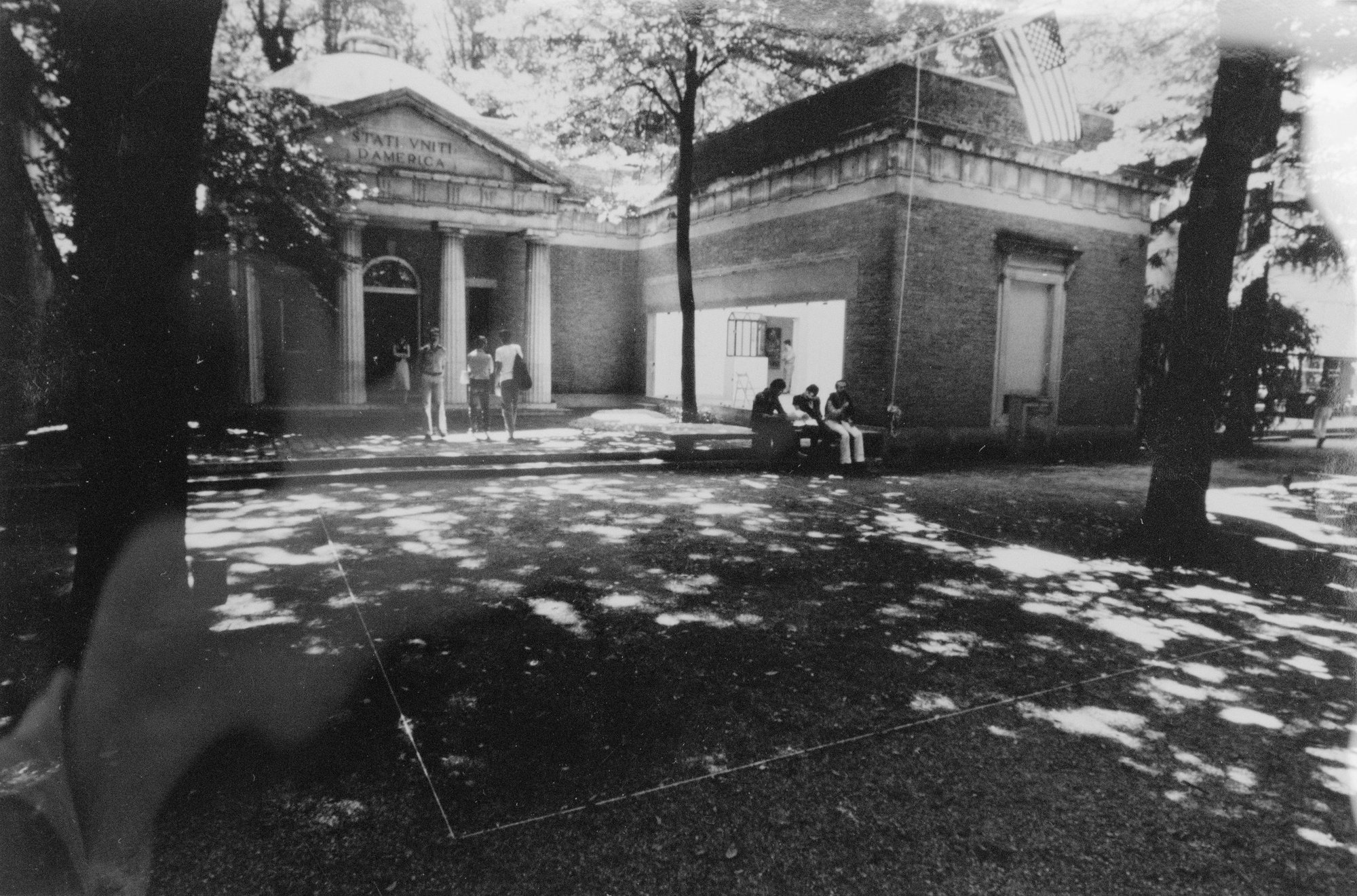
Irwin’s installation at the US pavilion at the 1976 Venice Biennale. Nails and rope on grass.
RI: When you say outside you mean other disciplines?
BO: Yes. Anthropology, medicine, space research, architecture. People are very interested in habitability. I feel that it can be powerful to make an art museum to be the center of this interest, like a hub, in a way that different disciplines connect there and exchange knowledge. When a medical doctor, artist and anthropologist talk about something they are all interested in, it can be art.
If you’d do it, reenact the Symposium, how would you approach it?
RI: That’s not an easy thing to recreate. The Symposium people all came together because a big historical project was the reward. Everybody wanted to be a part of it. The trip to the universe, it was an intriguing and beautiful problem.
They wanted to be there badly, and what brought them there had nothing to do with me. But I brought into the dialogue the questions of quality of experience, which is the subject of art. They tolerated my interference, which eventually turned out to be a major part of their discussion.
But why has this idea of cross-disciplining failed so many times? It’s such a good idea, of interdisciplinary dialogue. It’s a very desirable idea that everyone appreciates, but it’s very hard to find situations where it succeeded. If I were you, that’s the first thing I’d try to figure out: why hasn’t it worked.
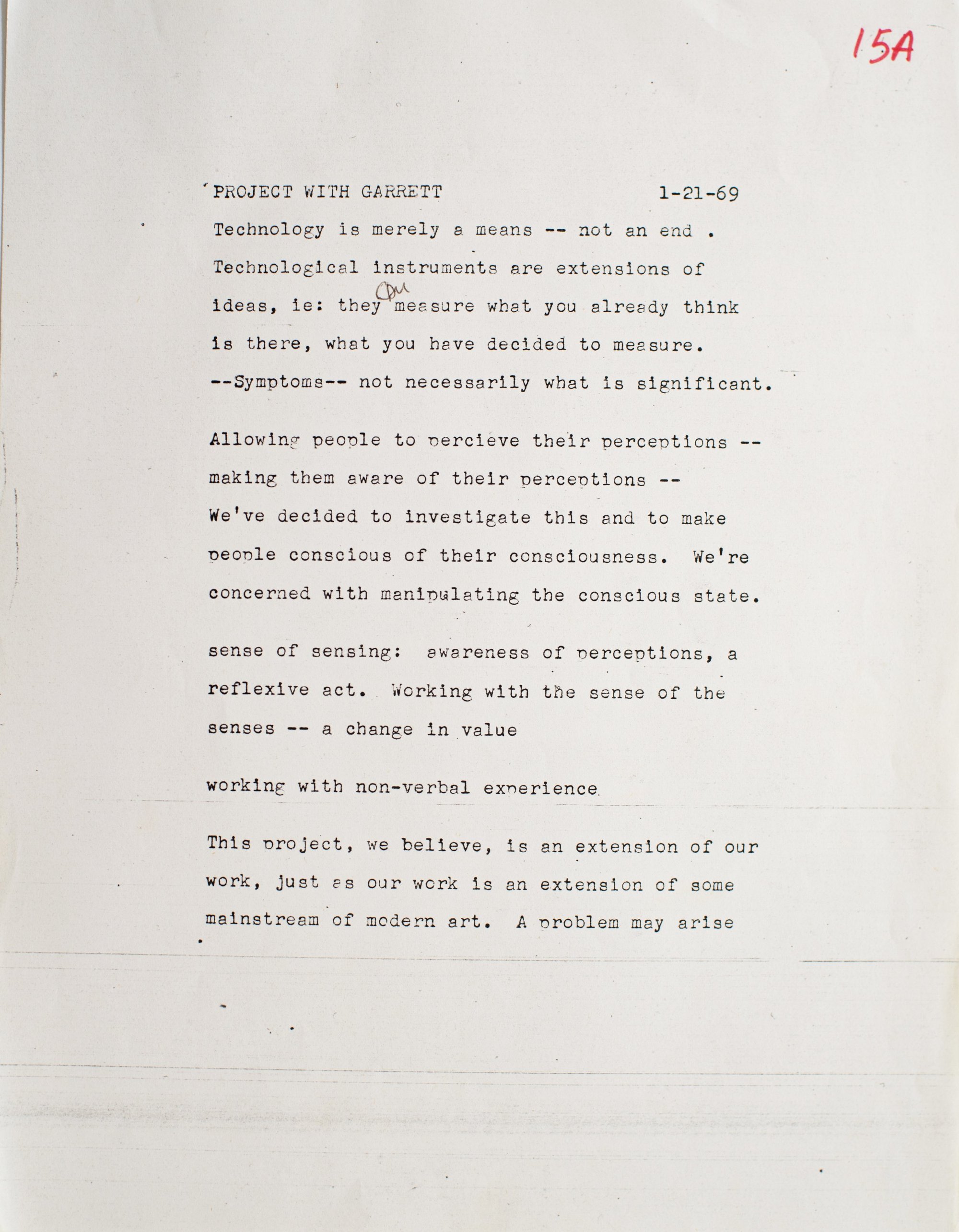
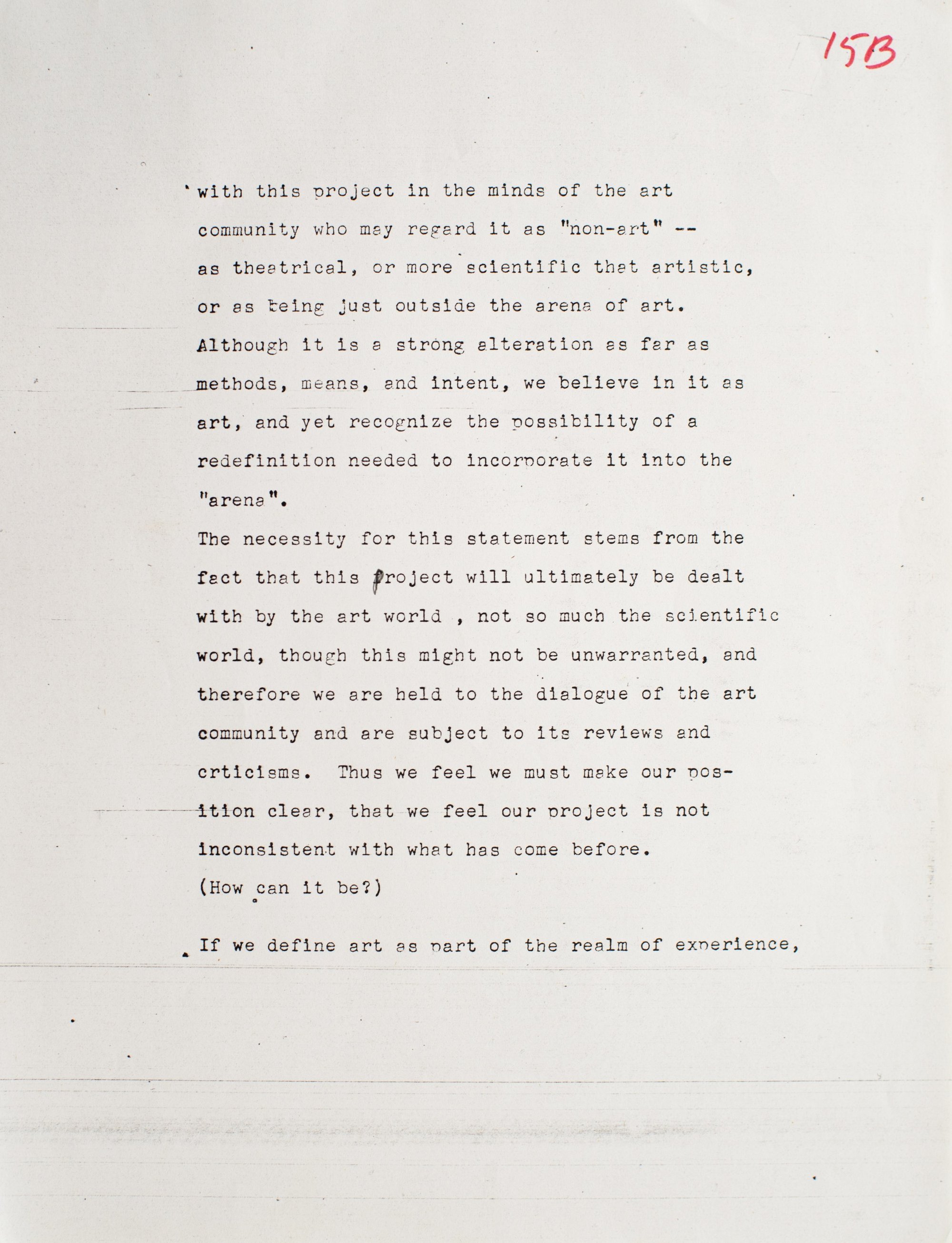
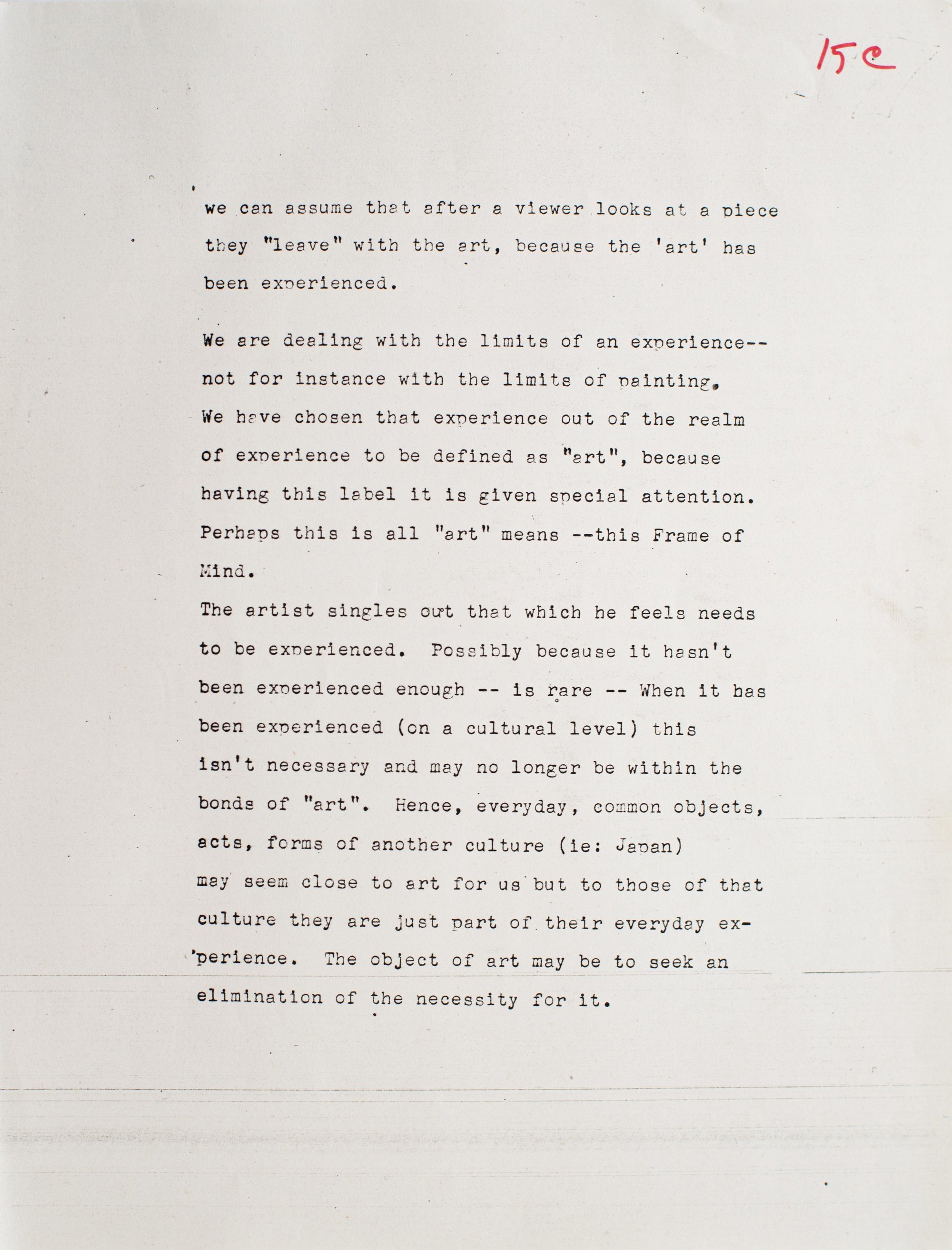
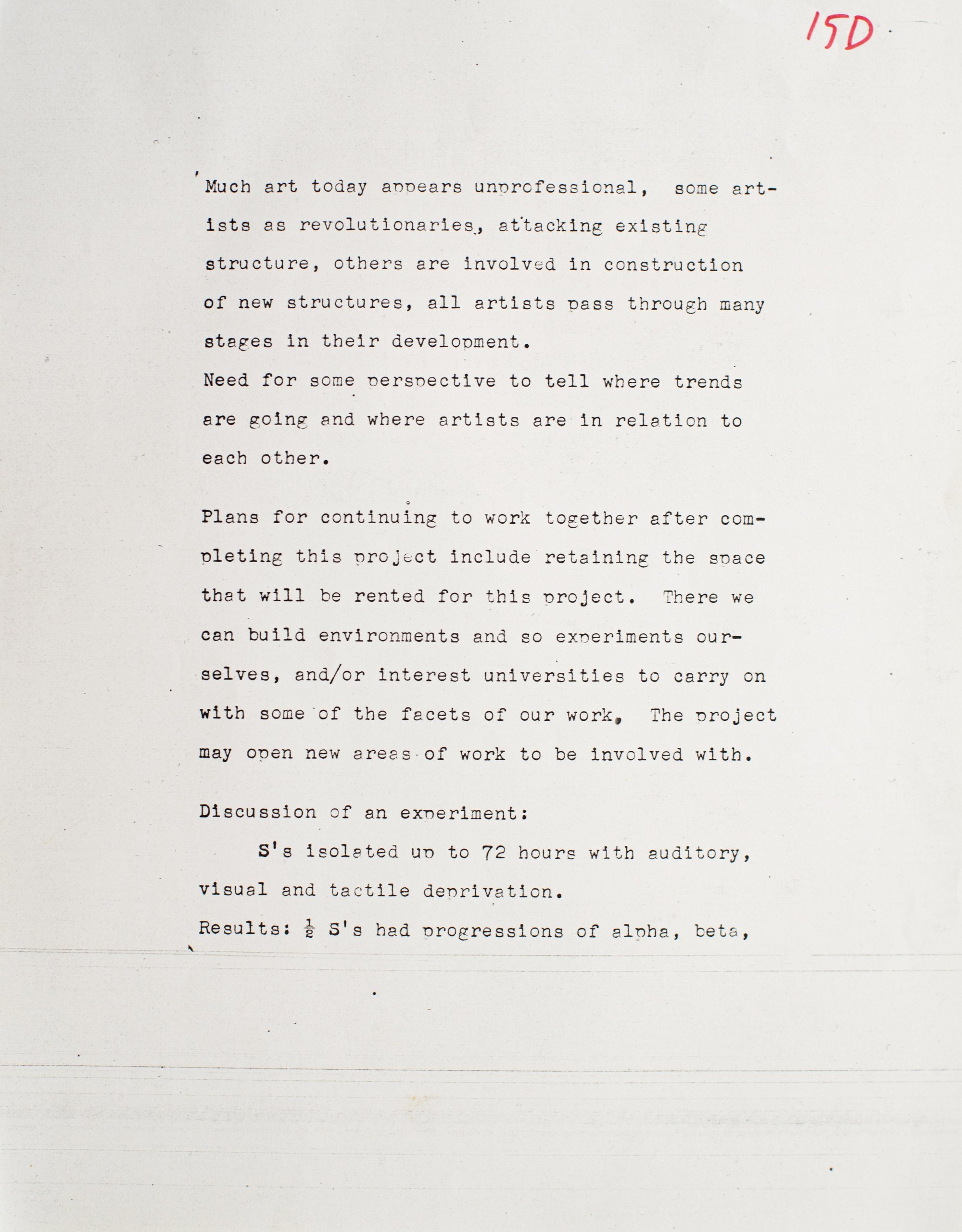
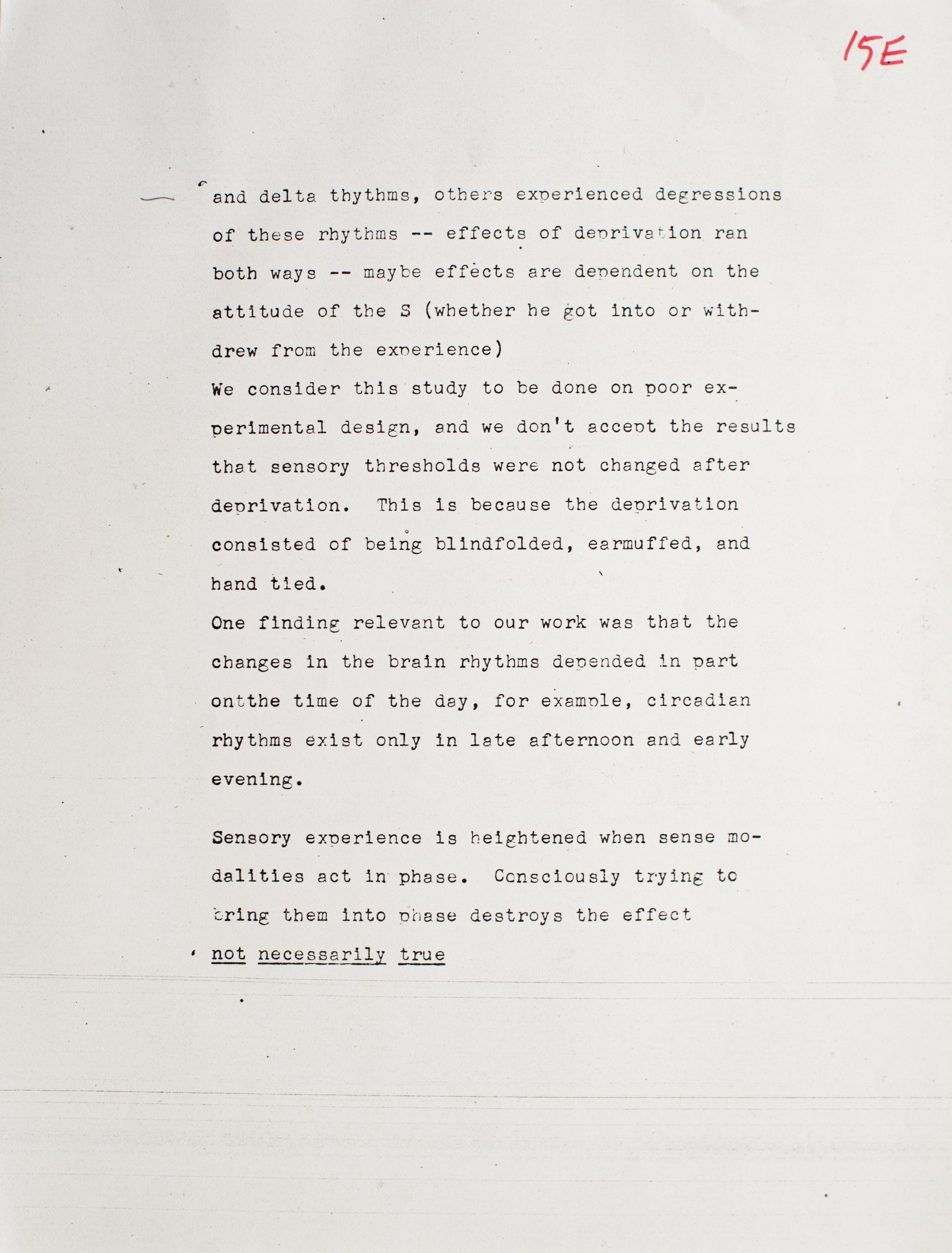
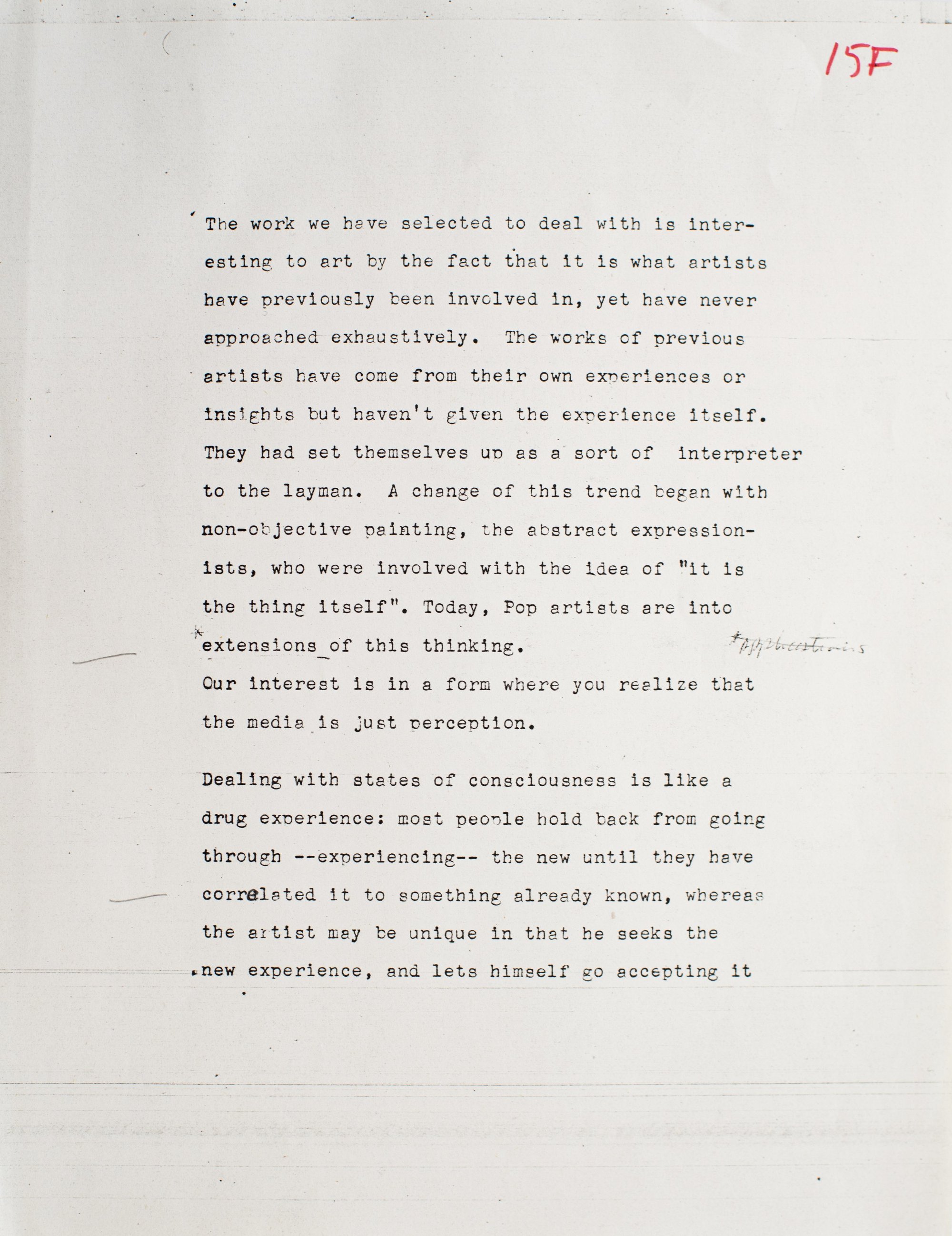
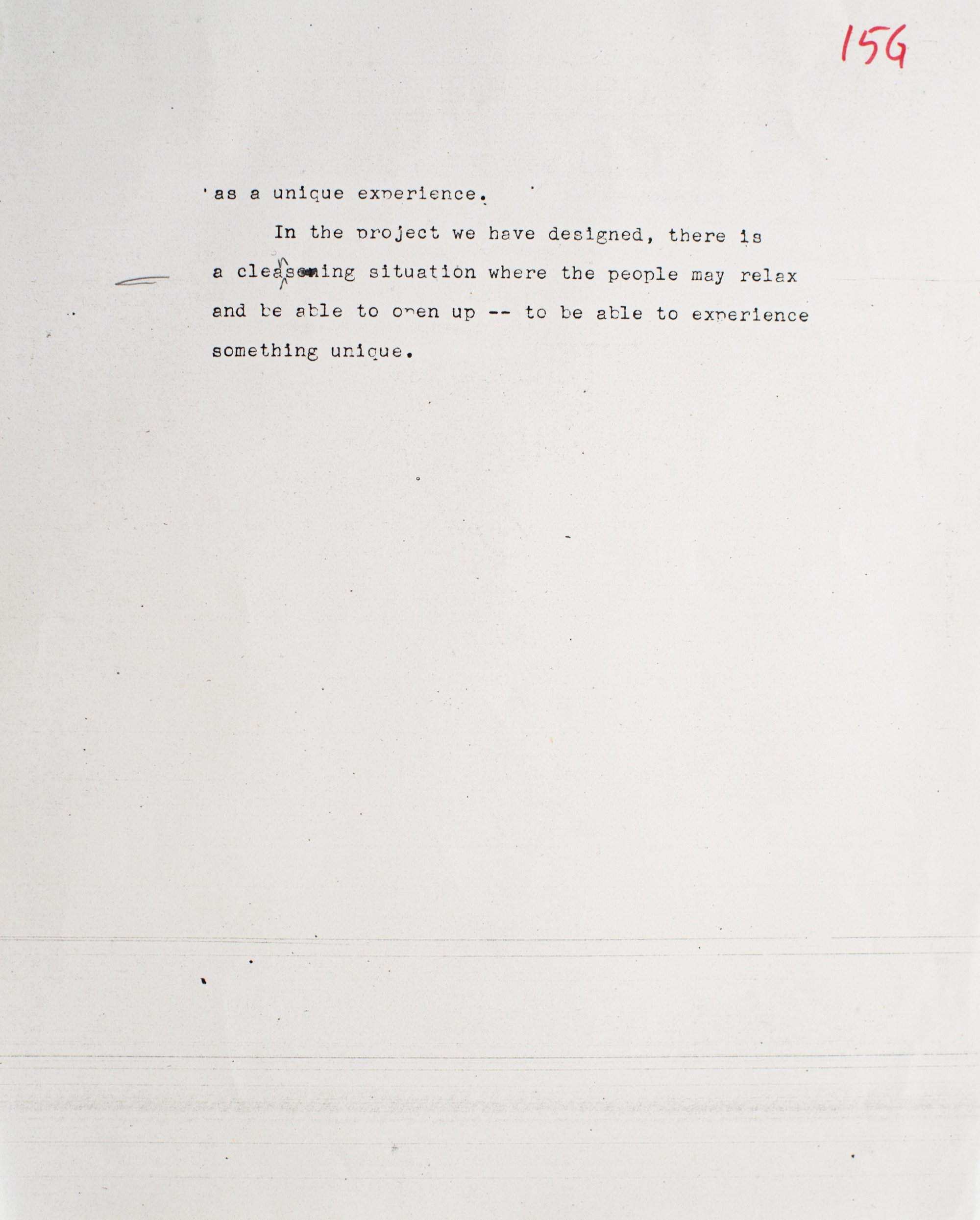
Drafts of Irwin, Turrell and Wortz’s draft texts for the Report on the Art and Technology Program
BO: Do you have a dream project that you wanted to do and never got to?
RI: I’ve actually just finished my dream project. Marfa. It was an opportunity I really wanted.
I haven’t seen it yet. I’ve seen the photographs, which are startling. The light comes in the back side, and it looks just magical. I almost don’t want to go there. It might not be as good as it looked on film.
I liked what Judd did, how he went to Marfa because he didn’t like how they showed his work in New York. He said, “I’m going to go find a place where I can do it my way, not getting stuck with what it means to be at MOMA.” Nobody asked him to come. There was no invitation.
He took whole buildings, like a Safeway Market, and if you go in there it’s all the little experiments. He took a bank, there’s a whole series of rooms, process. You have to see all the process. It’s not about the final product. You look and see a real artist doing real stuff.
The first time I met him there was by accident. I drove around the border of the States and had to go through Marfa because that was the closest to the border you could drive. And he was spending time there, beginning to buy up the town. We were both surprised, like “What the fuck are you doing here?”
The lady who made that place happen, Marianne Stockebrand, terrific lady. Tough as nails. She hung in there in Marfa in the days when there was nothing there.
Judd was a terrific artist, a standout in a group of standouts. He wasn’t just making art, he was changing the rules of the game.
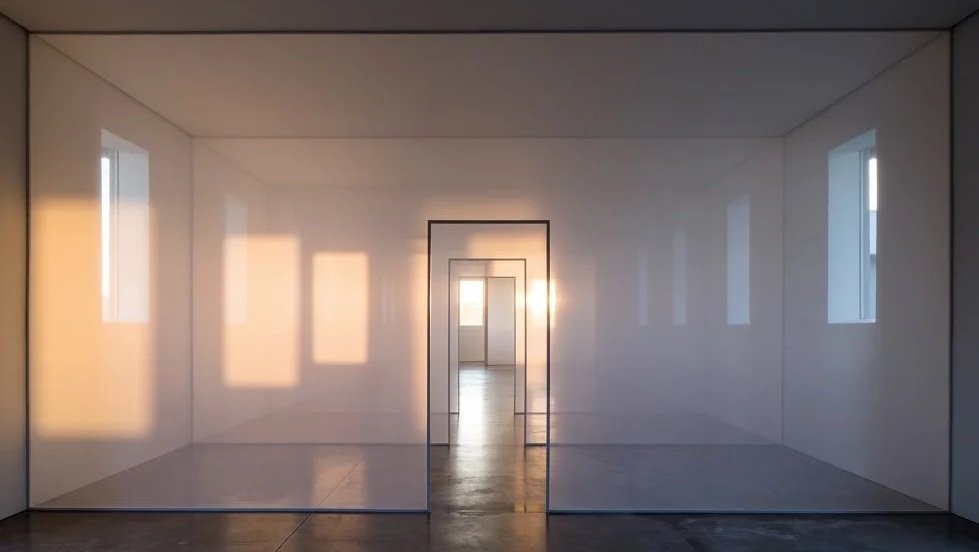
Dawn to Dusk, Chinati Foundation, Marfa, TX
BO: Did he actually change the rules of the game?
RI: Yes. That’s why I did a project there. He created a situation which for me was perfect. It was a terrific place to do what I did, especially right now.
At one point the Museum of Modern Art was an art museum. It was really close to what was going on in art. But what happened is they ended up with a huge, sensational collection. And they had a dilemma: what do we do with this? They decided to be the Museum of Modern Art, and then they ceased being the Museum of Modern Art. It’s a beautiful collection, but they don’t do jack shit really.
There was one lady at MOMA who was pushing it to do things. Jenny Licht. She had one little room and she did a series of projects that were live. She’d let me in after the museum closed, because the painters wouldn’t paint, the carpenters wouldn’t do carpentry, they wouldn’t do anything, because of the unions. So we had to do everything ourselves. She’d let me in at closing time and I would work all night. What I loved about it was, every time I went into this half-assed little room, right next door was a Brancusi!
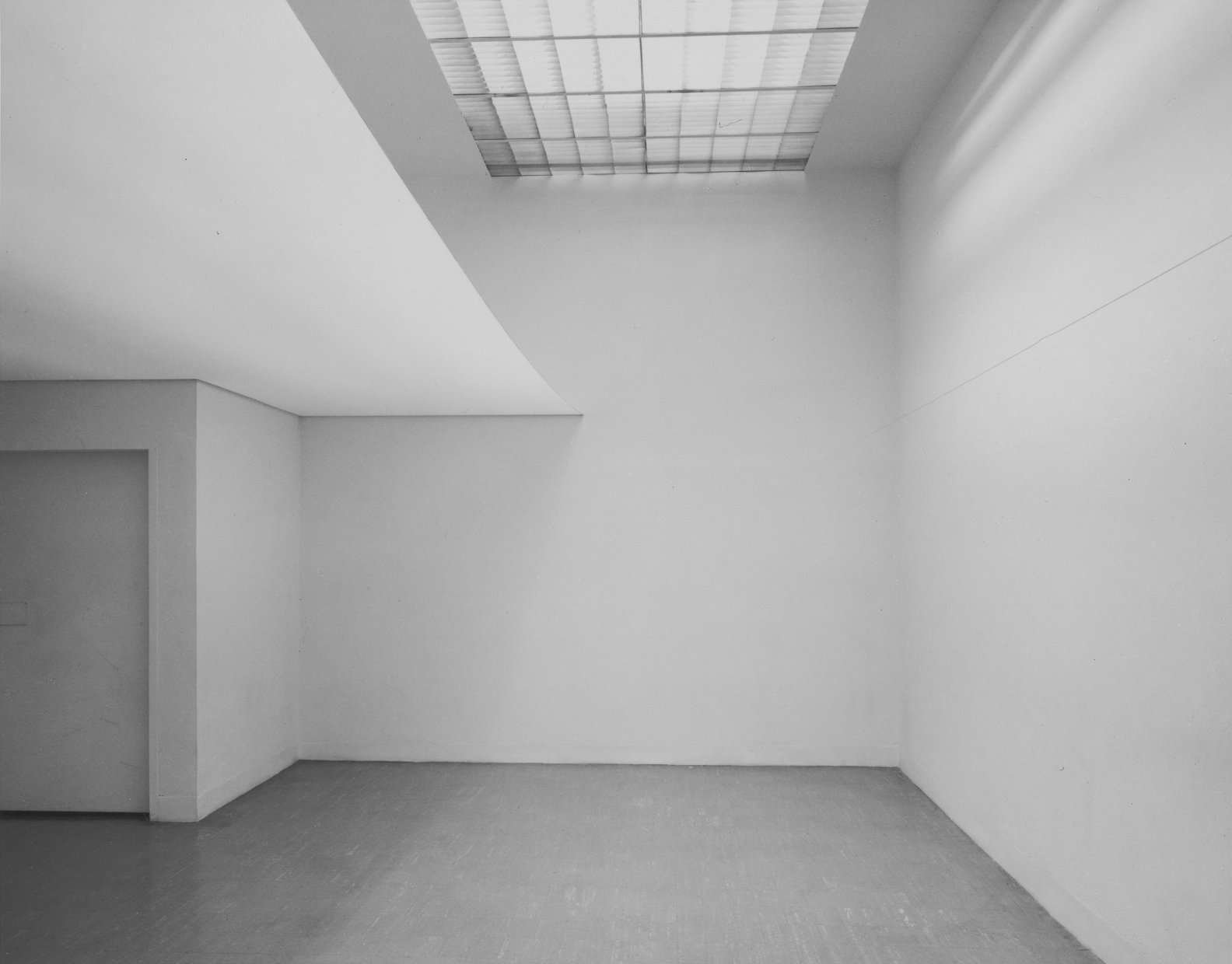
Irwin’s installation at MoMA, 1971
BO: If you could imagine a museum of the future, what would it look like?
RI: Well, it will probably look like Marfa. It doesn’t act as a museum, but in a way it is. You can go find everything that Judd did and how he did it, his house, his library, the materials, all the little experiments he’s been doing, not as an exhibition but as a process. Then I added something to that, and other artists added something else. I’d say that comes close.
Nobody’s asked me that question, I’ve never answered it, but my first answer is that Marfa is the best museum in the country right now. It’s the best response to New York I can think of.
It’s become a party town, which is not necessarily to do with Judd. He was the original reason for its existence, and now it’s becoming a destination for other reasons. There are people getting married there now.
BO: Many museums actually do that for income, hosting weddings. Not the worst place to get married!
RI: I did the Primal Palm Garden in LACMA. How I got that job was, I happened to be there the day Michael Govan, the director, was interviewing a landscape firm which was gonna do his grounds. He asked me to come and observe. They did a presentation about how they are going to plant some trees, and then at the end there was a lull and the guy asked me, what do you think? I said, “This is all nice, but there’s no rhyme or reason for how and what way you chose those trees and how you put them together.” And he said, “Okay smart ass, what would one be?”
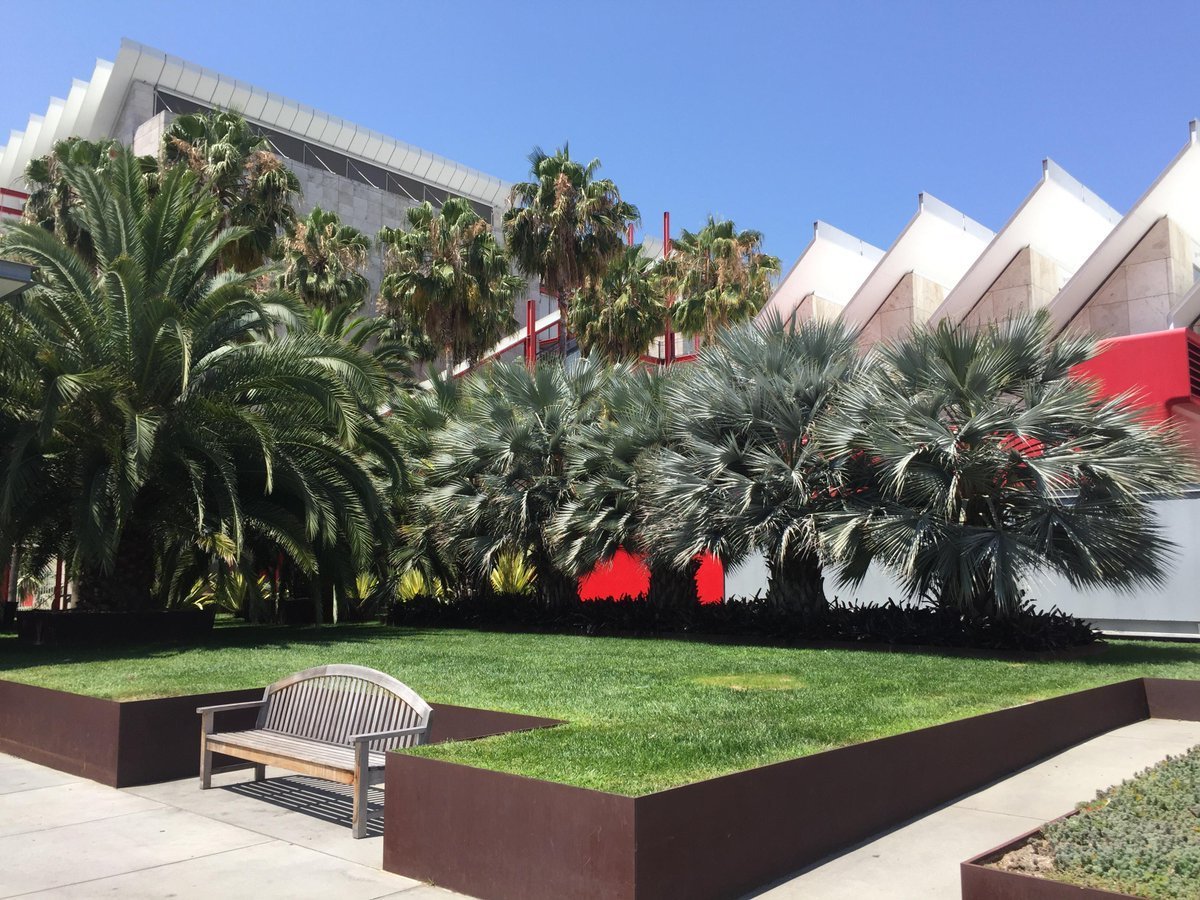
Primal Palm Garden, 2010, LACMA, Los Angeles, CA
Interestingly enough, literally that week, the mayor of Los Angeles had said that he was gonna get rid of palm trees, because they were a problem. But every time that you pick up a magazine or anything about LA, you see a palm tree. And right next door we have the La Brea Tar Pits! This amazing open tar pit, that every now and then coughs up a saber tooth tiger or a mammoth. When you look at it, it doesn’t look like anything, just looks like a dark black tar pit. And we’re on the same block!
So here we are, we’ve got the tar pits there, the palms in the middle of the street, why don’t we combine them into a garden?
Most people that go to the Getty Institute don’t enter the museum. They go to the garden I designed there. I didn’t know anything about gardens before I made it, but apparently I did make an authentic garden, and they come, and they are the best audience. They’re not the art world, they’re just so enthusiastic, and they’re knowledgeable. They know what it is and they appreciate it, boy they appreciate what I introduced into the world.
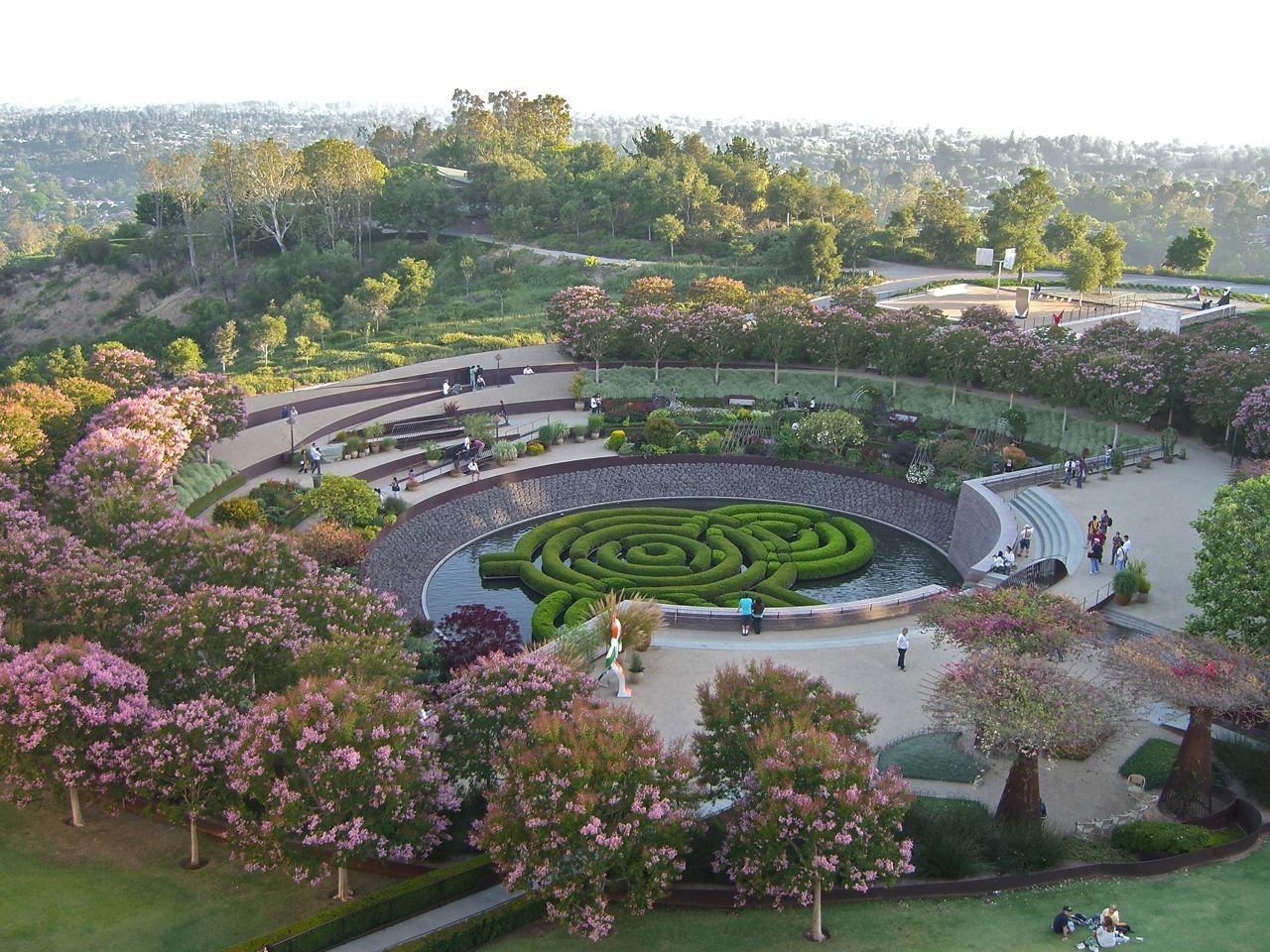
Getty Institute garden designed by Irwin
BO: There was this retrospective of your paintings at Hirshhorn in DC. They had a video interview with you, from the 70s, and in it there was one question about your motivation for being an artist. You answered that motivations are not static, they change over time. Did your motivations for being an artist change after the symposium?
RI: First of all, whether or not I even knew that at the time, that was worth the ticket. Everything else paled, whether I was making money, not making money, showing, not showing… The game was wide open, and I had the best game in town. The questions were real and ripe and exciting.
There were a lot of alternatives that you could make money with as an artist. But you’ve got the best game in town, why would you give it away for these temptations!? Why would you do these things when you’re having a real dialogue with the history of the discipline?
And I met Ed Wortz, who became a close friend and somebody I learned from the rest of my life. That alone was worth it.
BO: When I reenact the symposium in a few years, whatever shape it takes, what will make it interesting for you to come?
RI: I’d have to know a lot more. And I’m going to have to play a role of some kind, because I’m not an observer.
But also, at 90 years old, I don’t move around too well. I’m going to go to New York to do this show, and I have great trepidation. I have a lot of pain right now and sitting on an airplane for any length… I have not been to Marfa even, for my work there.
BO: I hope you come. Thank you so much for your time!
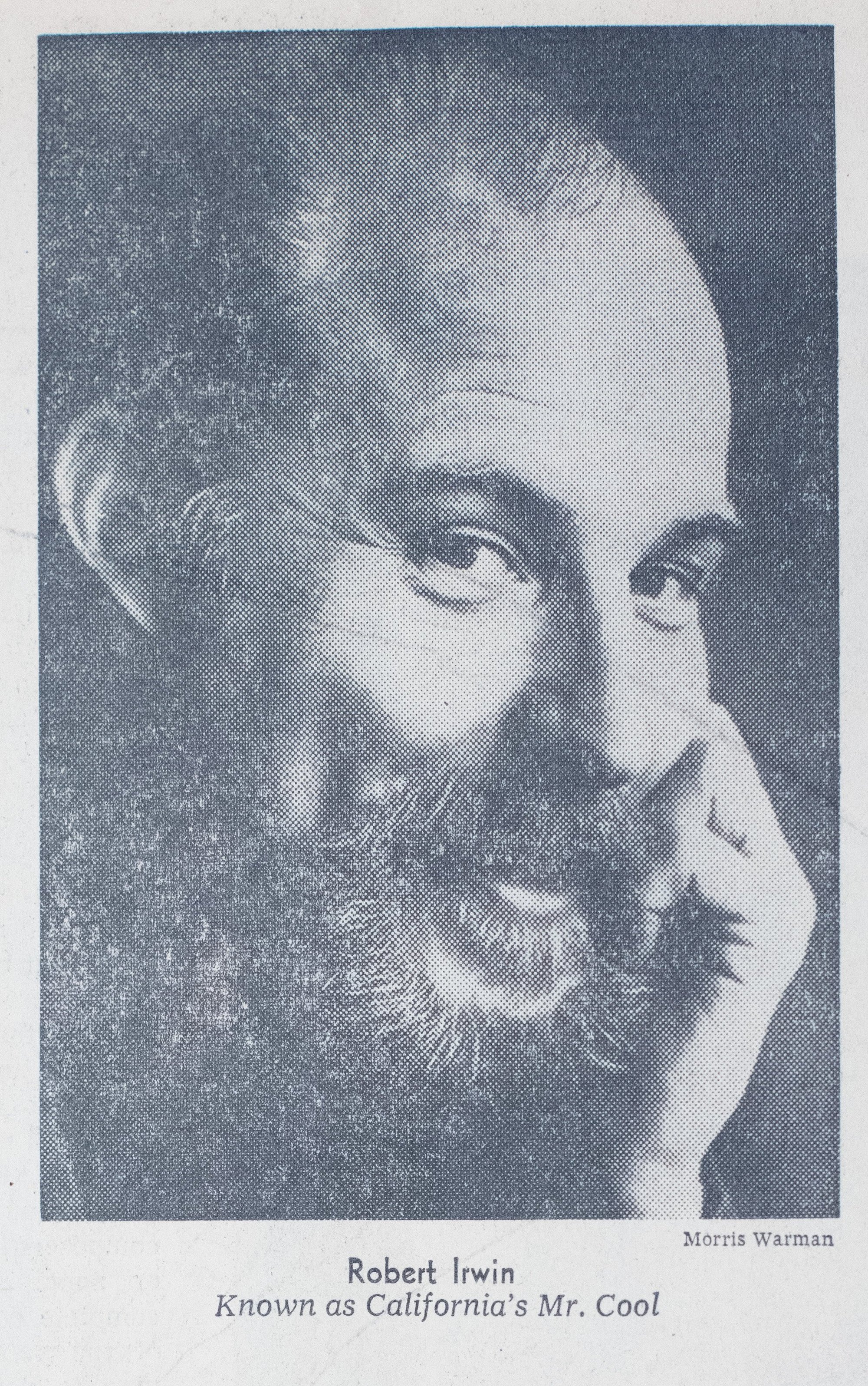
A Rainy Taxi, a Tea Cup Of Fur, The New York Times, 1968